
 Lietuviškai
 Deutsch
 Français
 Русский
 Español
 Polski
 Italiano
 Українська
 Čeština
 Português
 日本語
日本語 Latviešu valoda
 Eesti
Eesti Magyar
 Bahasa Indonesia
 Türkçe
 हिन्दी
 Ελληνικά
 العربية
 ไทย
ไทย Tiếng Việt
 Română
 Bahasa Melayu
 বাংলা
বাংলা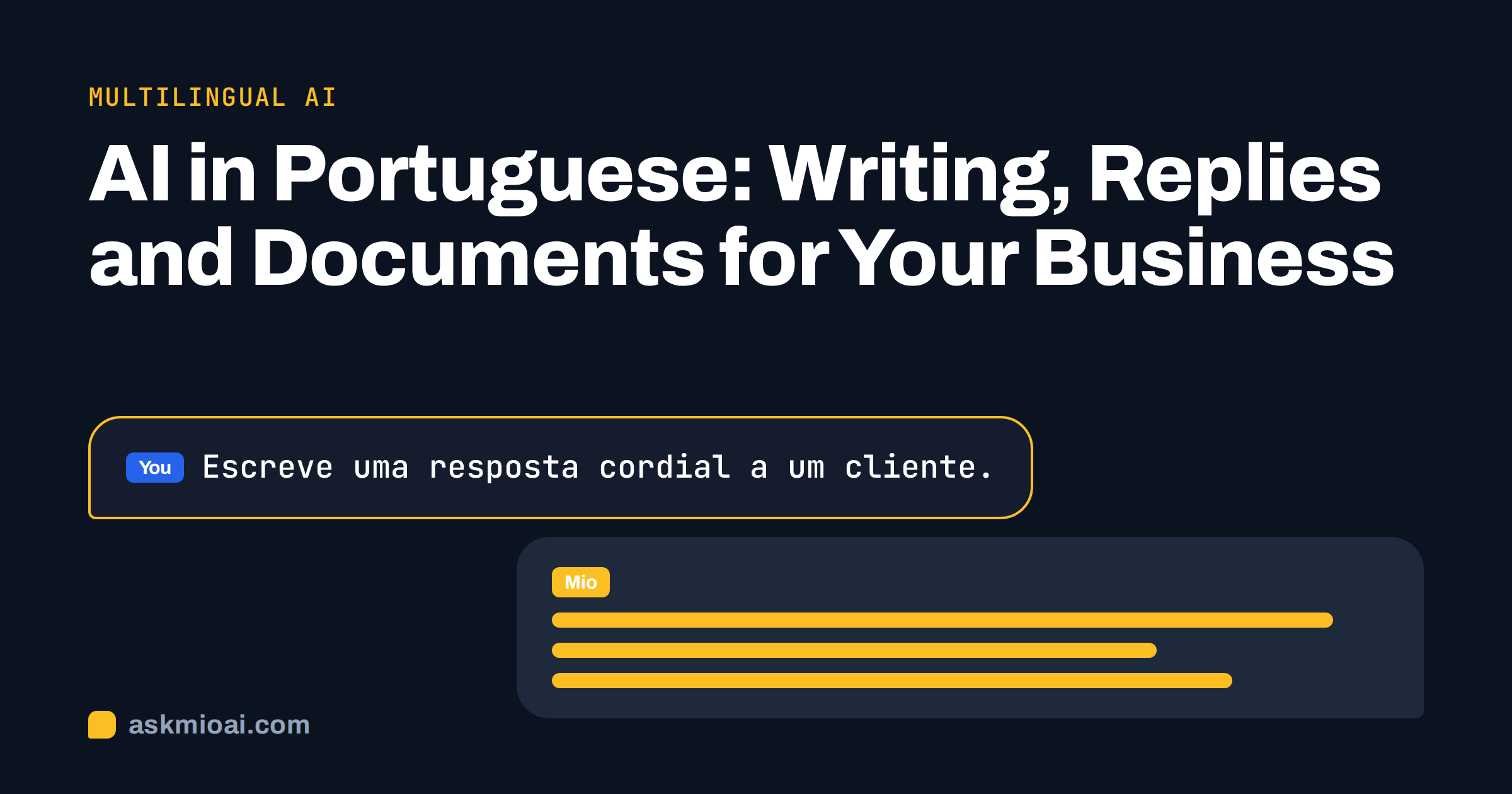
Using AI in Portuguese works well for everyday business writing, but only if you tell the assistant which Portuguese you mean. Portugal and Brazil share a language yet differ in vocabulary, spelling habits, forms of address and tone, and a reply that sounds natural in São Paulo can feel foreign in Lisbon. The assistant can write in either, but it needs the instruction, and you need to review the result with a native reader’s eye.
This guide explains how to get good results with AI in Portuguese for e-mails, customer replies, websites, documents and translation. It covers the differences between the two main variants, prompts that work, a review routine, privacy points for Portuguese-language businesses, and where human help is still the right choice.
Which Portuguese do you need?
This is the first decision, and the most common source of awkward results. The Portuguese language is spoken across several countries, with Brazil and Portugal as the two main written standards for business.
Differences that matter in writing
- Vocabulary. Everyday words differ: “autocarro” in Portugal, “ônibus” in Brazil; “telemóvel” against “celular”; “casa de banho” against “banheiro”.
- Forms of address. European Portuguese often uses “o senhor” or “a senhora”, or the third person, in formal writing, while Brazilian business writing commonly uses “você” and “senhor/senhora” depending on the context.
- Verb forms and pronoun placement. Continuous forms such as “estou a fazer” (Portugal) against “estou fazendo” (Brazil) are an obvious tell.
- Spelling. The Portuguese Language Orthographic Agreement of 1990 brought the standards closer, but differences in spelling and in some words remain.
- Tone. Brazilian business messages are often warmer and more personal, while European messages can be more reserved. Both vary by industry.
Say it in the first line
Start every task with the variant: “Write in European Portuguese, formal, for customers in Portugal” or “Write in Brazilian Portuguese, friendly but professional”. Then repeat the instruction in a project or in the first message of each chat so it does not drift back to a default.
Good uses of AI in Portuguese for business
Assistants are strongest where the task is structured and the facts come from you.
Customer replies and e-mails
Paste the customer’s message and your facts, such as the order status or the policy, and ask for a polite reply in the right variant. The E-mail reply job in Ask Mio produces a ready-to-send answer in the tone you choose. For recurring cases, put a short style guide in a project so the voice stays consistent across your team.
Website and product text
Write product descriptions, service pages and FAQs directly in Portuguese instead of writing in English and translating. The result usually sounds more natural, because the assistant composes in the target language rather than mirroring English sentence structure. Our guide to localising a website with AI covers the process in detail.
Summaries and reports
Upload a Portuguese document or paste a text and ask for a summary, a list of decisions or a plain-language explanation. This is useful for contracts, reports and long e-mail threads, as long as you verify the key points against the original.
Learning and practice
The Language tutor expert helps you practise, correcting mistakes and explaining why. It is useful for learners who work with Portuguese-speaking partners and want to write with confidence.
Prompts that work
You can write the prompt in English or in Portuguese. What matters is that it is specific. Our guide to non-English AI prompts explains why both options work.
A reliable template
“Write a reply in European Portuguese, formal, to the customer message below. Use ‘o senhor’. Apologise once, state the facts I give you, offer the next step and keep it under 120 words. Do not invent dates or prices.”
An example in Portuguese
“Escreve uma resposta cordial a um cliente no Brasil, em português do Brasil, que pergunta pelo estado da encomenda. Usa ‘você’, mantém o tom profissional e acrescenta o número de seguimento que indico abaixo.” The assistant understands requests like this directly.
Ask for two registers
If you are unsure how formal to be, ask for a formal and a friendly version and choose. Then tell the assistant which one you picked and ask it to keep that register from now on.
Lock your terms
Give a short glossary: your product names, preferred words and phrases you never use. “Always write ‘fatura’ for invoice, never ‘nota'” prevents inconsistencies across documents.
A review routine for Portuguese text
Fluent output is not the same as correct output. A quick routine catches the typical problems.
- Check the variant. Scan for words and verb forms that belong to the other standard.
- Check the register. Does it address the reader as you intended?
- Check numbers, dates and names. Confirm formats such as 1.250,50 € and day-month order.
- Check the facts. The assistant must not have added a promise, a price or a deadline.
- Read it aloud. Awkward rhythm or false friends tend to stand out.
- Get a native reader for important text. Contracts, advertising and public statements deserve a human check.
Our overview of AI translation quality describes the errors to expect and how to reduce them.
Portuguese variants compared
The table shows the main points to specify in a prompt.
| Feature | European Portuguese | Brazilian Portuguese | Prompt tip |
|---|---|---|---|
| Bus / mobile phone | autocarro / telemóvel | ônibus / celular | Name the country of the reader |
| Ongoing action | estou a fazer | estou fazendo | Check verb forms in the draft |
| Formal address | o senhor, a senhora, third person | você, senhor, senhora by context | State the form of address |
| Typical business tone | Often more reserved | Often warmer | Describe the tone you want |
| Currency and number format | 1.250,50 € | R$ 1.250,50 | Give the currency and format |
| Data protection framework | GDPR | LGPD | Ask your adviser; do not rely on the assistant |
A worked example: one message, two markets
Imagine a small online shop that ships to customers in both Portugal and Brazil. A customer writes that a parcel has not arrived. The shop owner has the facts: the order shipped five days ago, the tracking shows it at a regional depot, and a replacement or refund is available after ten working days.
The prompt
The owner pastes the facts and asks for two replies, one in European Portuguese for a customer in Porto and one in Brazilian Portuguese for a customer in Curitiba. Each must apologise once, give the tracking status, state the ten-working-day rule exactly as written and offer help. Both stay under 100 words.
What to expect and what to check
The two replies should differ in more than a few words. The Portuguese version may use a more reserved opening and a form of address such as “o senhor”, while the Brazilian version may be warmer and use “você”. The owner then checks three things: that the ten-working-day rule appears unchanged, that no new promise was added, and that the currency and date formats match the market. A native colleague or friend can read both in a minute.
Saved in a project, this pair of instructions becomes a reusable routine. The next complaint takes a minute instead of a quarter of an hour, and the wording stays consistent, which customers notice even if they cannot say why.
Habits that keep Portuguese output consistent
Consistency is what separates a company that uses AI well from one that produces a patchwork of voices. A few habits are enough.
- One owner for the glossary. Someone decides the preferred terms and updates the list when products change.
- Two or three model texts. Add examples of replies you are proud of to the project, and ask the assistant to match their style.
- A monthly spot check. Read ten recent messages for drift in variant, tone or terminology and adjust the instructions.
- A list of banned phrases. Cold clichés and literal translations of English idioms are easy to forbid once you have noticed them.
These habits cost almost nothing, and they make every later request shorter, because the standard is already in the project instead of in each prompt.
Privacy and legal points
Portuguese-language businesses often work across borders, which affects which rules apply.
Personal data
Businesses in Portugal operate under the GDPR, while those serving customers in Brazil must consider Brazil’s own data protection law. The assistant can help you draft a plain-language privacy notice, but it is not a lawyer, and a legal adviser should review the final text. Keep customer names, addresses and identity numbers out of prompts where possible, and use placeholders instead.
Where your data goes
Ask Mio states that chats and files belong to the user, can be exported or deleted at any time, are not used to train models and are processed on servers in the EU (Germany). Our article on EU-hosted AI and GDPR explains what that means in practice.
Legal and official documents
The Contract and document check job gives a plain-language summary and highlights risky clauses, but it is not legal advice. For anything binding, use a qualified professional who knows the legal system of the country involved.
Working with Ask Mio in Portuguese
Ask Mio answers in your language, and the site and product are available in more than 25 languages, including Portuguese. You can write your request in Portuguese and receive the answer in Portuguese, or mix languages when it suits you, such as an English brief with a Portuguese deliverable. Mio chooses the model for the request, so you do not pick one for Portuguese specifically.
A practical setup is a project for each market. Put the variant, the tone, the glossary and two examples of text you like into the instructions, and attach your product sheet. Every chat in that project then starts from the same standard. Our guide to AI projects and memory shows how to set it up. For a wider look at working across languages, see the multilingual AI assistant guide.
Where AI in Portuguese still needs a human
- Advertising and slogans. Wordplay and cultural references rarely survive automatic writing.
- Legal, medical and financial text. Precision and responsibility matter more than speed.
- Regional expressions. Slang from Angola, Mozambique, Cape Verde or specific Brazilian regions can differ from the standard forms.
- Brand voice. Even a good draft needs a person who knows how your company speaks.
- Sensitive messages. Apologies, complaints and bad news need careful judgement.
Frequently Asked Questions
Can AI write good European Portuguese?
Yes, if you ask for it clearly. Say “European Portuguese” and the country of your reader, name the tone and form of address, and review the draft for words and verb forms from the Brazilian standard. Assistants often default to the more widespread variant, so the instruction and a quick check make a real difference.
Should I write my prompt in Portuguese or English?
Either works. Write in the language in which you can be most precise. If your instructions are clear in English, you can ask for the output in Portuguese. If you want to practise or keep everything in one language, write in Portuguese. Always state the variant and register you want for the final text.
Is AI translation into Portuguese reliable enough to publish?
For internal use and first drafts, usually yes. For published pages, contracts and advertising, have a native speaker review it. Check names, numbers, legal terms and tone, and keep a glossary so the same term is used everywhere. Writing directly in Portuguese often reads better than translating English text.
Does Ask Mio support Portuguese?
Yes. The site and product run in more than 25 languages, Portuguese among them, and Mio answers in your language. You can write requests in Portuguese, get answers in Portuguese and ask for either variant. You do not choose a model; Mio selects the one that suits each request.
Can I use AI for customer support in Portuguese?
Yes, as a drafting aid. Give the assistant your policies and the customer’s message, ask for a reply in the right variant and tone, and review before sending, especially for refunds, legal matters or complaints. Keep personal data out of the prompt where you can, and use a project to keep wording consistent.
The Bottom Line
AI in Portuguese is dependable for e-mails, replies, summaries and first drafts when you name the variant, the register and the facts, then review the result like a native reader. Save a glossary and a style guide in a project, keep personal data out of prompts, and bring in a human for legal, advertising and sensitive text. To try it on your own messages, start with Ask Mio’s free plan.