
 Lietuviškai
 Deutsch
 Français
 Русский
 Español
 Polski
 Italiano
 Українська
 Čeština
 Português
 日本語
 Latviešu valoda
 Eesti
 Magyar
 Bahasa Indonesia
 Türkçe
 हिन्दी
 Ελληνικά
 العربية
 ไทย
 Tiếng Việt
 Română
 Bahasa Melayu
 বাংলা
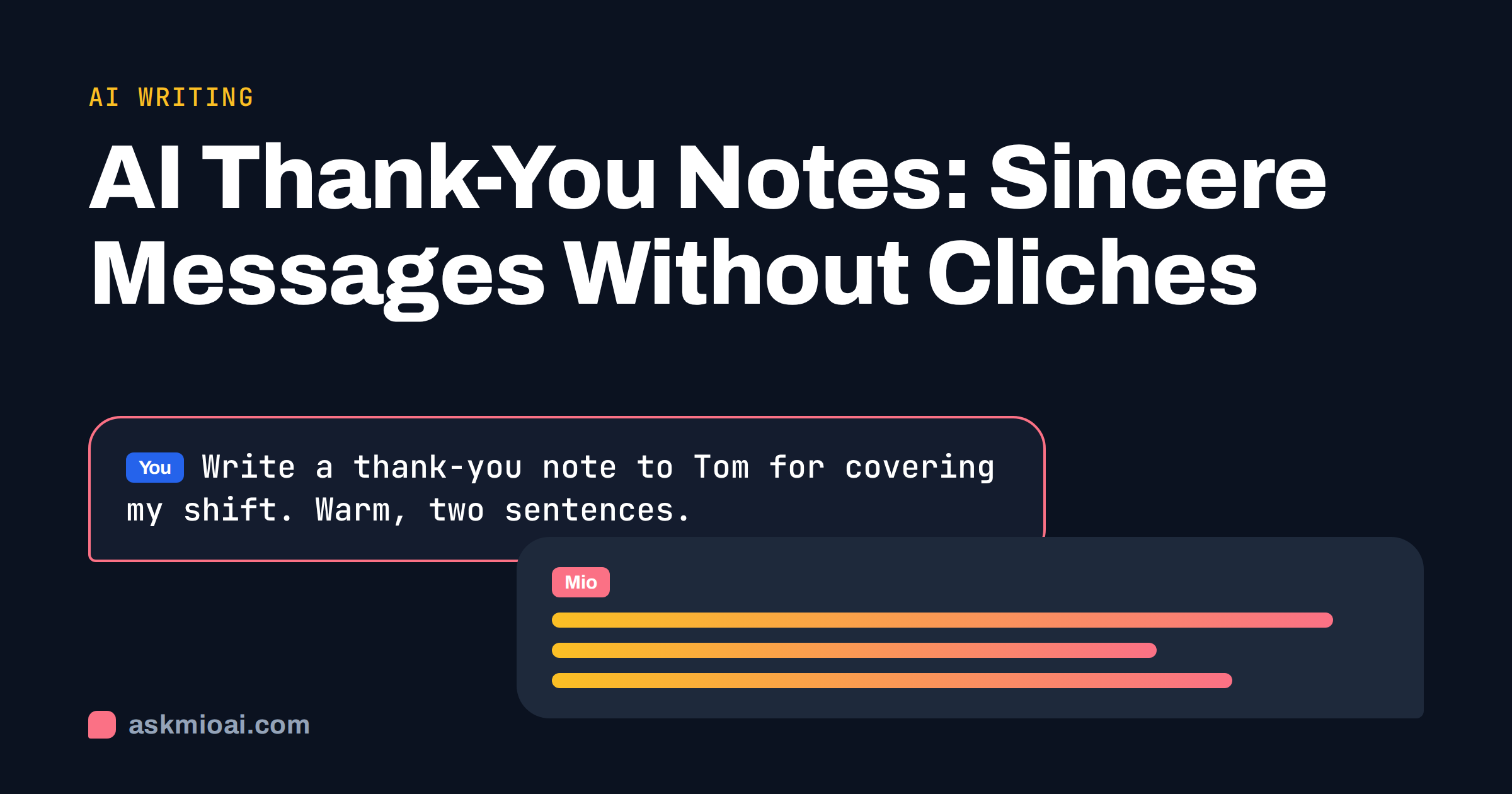
AI thank-you notes can help when you know what you want to say but not how to say it, and they can ruin the moment when they sound like a template. A thank-you note works because it is specific and personal: it shows that you noticed what someone did and what it meant to you. An assistant has no idea what happened, so the quality of the note depends on the one real detail you give it.
This guide shows how to write thank-you notes with AI that still sound sincere: what to tell the assistant, how to set the tone for different people, how to remove cliches, how long a note should be and when to write by hand. The examples cover personal gifts, colleagues, customers, interviews and teachers, and they work with any capable assistant, including Mio.
Why thank-you notes are hard to write
Most people know they should say thank you and delay it because the words feel awkward. The fear is of sounding insincere, too formal, too gushing or too brief. Time passes, and the moment gets harder. A short, warm note sent within a few days is nearly always better than a perfect one sent in a month.
An assistant removes the blank page. It can offer a structure, a few openings and a tone, and you can adjust. The risk is the opposite problem: AI text tends to be smooth, enthusiastic and generic, with phrases such as “I am so grateful for your incredible support”. Readers recognise that language. The cure is simple and has nothing to do with technology: include something only you would know. Writing about gratitude has long shown that specific appreciation lands better than general praise.
The ingredients of a good note
A sincere note has four parts, and an assistant can help you with each.
- The thanks. Say thank you plainly, near the start.
- The specific thing. Name the gift, the help or the action, with one concrete detail.
- The effect. Say what it meant or how you used it.
- The warm close. A short forward-looking line: a plan to meet, a wish, an invitation.
Three to five sentences are often enough. A longer note works for a mentor, a host or someone who did something major, but length is not the same as warmth. Give the assistant the four ingredients as notes and ask it to join them in your voice.
A prompt pattern for AI thank-you notes
The prompt should hold the facts, the relationship and the tone. Ask for several short versions, because you will pick and mix. Tell the assistant what to avoid.
Write three versions of a thank-you note, each under 60 words.
To: Tom, a colleague who covered my Friday shift when my child was ill.
From: me (Anna). Relationship: friendly, same team for 2 years.
Specific detail: he also reorganised the shelf so I could find things.
Effect: I could stay home and Monday was calm.
Tone: warm, a little humorous, not formal. No emoji.
Avoid: "incredible", "above and beyond", "from the bottom of my heart".
End with an offer to buy coffee on Monday.
The “avoid” line is more powerful than it looks. It removes the stock phrases that make notes sound like greeting cards. Add your own list of words you never use. For help with this kind of prompt in general, our guide to writing an AI prompt that works explains the structure.
Tone for different people
| Recipient | Tone | Length | Tip |
|---|---|---|---|
| Close friend or family | Warm, personal, informal | 2 to 4 sentences | Mention a shared memory |
| Colleague | Friendly, concrete | 2 to 4 sentences | Name what changed for you |
| Manager or senior person | Respectful, specific | 3 to 5 sentences | Focus on what you learned |
| Customer | Courteous, appreciative | 2 to 3 sentences | Refer to their order or feedback |
| Interviewer | Professional, brief | 3 to 5 sentences | Mention one topic from the conversation |
| Teacher or mentor | Sincere, specific | 4 to 6 sentences | Describe a concrete lesson |
| Host after a visit | Warm, detailed | 3 to 5 sentences | Mention a meal or a moment |
Cultures differ on formality and timing. In some places a handwritten card is expected, in others a quick message is fine. Check local habits if you write across borders; general etiquette varies more than people expect.
Removing cliches and robot phrases
After the first draft, read it with a sceptical eye. Look for words that feel inflated: “incredible”, “amazing”, “invaluable”, “truly grateful”. Look for sentences that could be sent to anyone, and for stacked thanks, such as three thank-yous in a row. Replace each with something concrete: instead of “Your support meant the world”, write “Your note before the exam made me calm enough to sleep”. A cliche is a phrase that has been used so often that it has lost its meaning, and a thank-you note is a place where meaning matters.
Ask the assistant for help with this too: “List any phrase in this note that sounds generic and suggest a concrete alternative based only on the facts I gave you.” Check that it does not invent facts, such as a memory that never happened. A false detail is worse than a general one, because the recipient will notice.
Notes in business settings
In business, thank-you notes build relationships quietly: after an interview, a sale, a referral, a meeting or a long project. Keep them short, specific and free of hidden requests. A note that thanks a customer and then adds a sales pitch stops being a thank-you note. For interviews, send it within a day, thank the person by name, mention one topic you enjoyed and restate your interest briefly. Our guide to AI cold e-mail writing covers the opposite situation, where you write to someone who does not know you yet.
For a team, a standard template saves time but should be personalised. Ask the assistant for a skeleton with slots for name, specific contribution and effect, and fill them in yourself. If your company has a recognisable voice, include it; see our brand voice guide. For longer messages such as newsletters to supporters or customers, our guide to AI newsletter writing adds structure.
Before and after: from generic to sincere
A first draft from an assistant, given only “thank a colleague for help”, often reads like this: “Thank you so much for your incredible help yesterday. I truly appreciate everything you do for the team, and I am so grateful to work with someone like you.” Nothing in it is wrong, and nothing in it is true in a specific way. It could be sent to anyone.
Now add one detail and ask for a warm, short tone: “Tom, thank you for covering my Friday shift. Because of you I could stay home with Leo, and when I came back on Monday the shelf was even tidier than I left it. Coffee is on me.” The second version is shorter, has a name, a fact, an effect and a small joke, and it is far more likely to be remembered. The difference is not clever technology but a single honest detail.
Practise the habit: before you ask the assistant for anything, write one sentence that only you could write, such as “he stayed late to fix the printer so my invoices went out”. Then let the assistant build around it.
Group thanks, other languages and special cases
Sometimes the thanks go to many people: a volunteer team, a class, a project group or all customers after a launch. Name groups or roles clearly and include a few concrete highlights, such as the number of events run or a problem solved, so that the message does not feel mass-produced. When you can, add a short personal line to a few key people. Do not use a group note as a way to avoid thanking one person who did something special.
If you write in another language, tell the assistant the language, the level of formality and the relationship, and ask it to avoid literal translations of English phrases. Customs differ: some languages have a polite and an informal “you”, and some expect longer greetings and closings. Have a native speaker check important notes. Our guide to working with a multilingual AI assistant shows how to set this up.
Finally, remember special situations, such as thanking someone after a loss, a medical event or a difficult period. Keep these notes simple, avoid exaggeration and let the recipient set the pace. If in doubt, a brief, kind message that you wrote yourself is better than a polished draft.
When to write it yourself
Some notes should be fully yours: condolences, apologies, thanks for a deep personal kindness, wedding and baby gifts from close family. In these cases an assistant can help you plan, for example by asking questions that remind you what to mention, but the words should come from you. Handwritten cards carry extra weight, because the effort is visible. You can still use an assistant to produce a first draft and then copy it by hand in your own style, changing anything that does not feel like you.
Also consider the occasion for visual elements. A card design, a printed note or a small illustration can add charm. See our guide to designing greeting cards with AI if you want to create a matching card.
Working with Ask Mio on thank-you notes
Mio’s Write mode drafts several versions in seconds, and Chat lets you refine tone and length. You never choose a model; Mio routes each request to a suitable one. Create a project called “Notes” with your usual sign-off, words you avoid and a few examples of notes you like, and every request starts from your own style. The free plan covers Chat and Write, which is all you need. Compare plans on the pricing page.
Chats and files are not used to train models, and you can export or delete them at any time. Keep private details to a minimum: you rarely need to give a full name, an address or health information to get a good note.
Frequently Asked Questions
Is it rude to use AI for a thank-you note?
Not if the note is sincere, specific and edited by you. The recipient cares about the thought and the facts, not the tool. Avoid it for deeply personal messages such as condolences, where your own words matter most, and never invent details that did not happen.
How do I make an AI thank-you note sound like me?
Give a real detail, name your tone, list phrases to avoid and show one or two examples of your own writing. Then edit: shorten sentences, replace generic words with concrete ones and read the note aloud. If a sentence is not something you would say, change it.
How long should a thank-you note be?
Usually two to five sentences. Say thank you, name the specific thing, say what it meant and close warmly. Longer notes suit mentors and hosts, but length is not warmth. A short, timely note beats a long one that arrives late.
When should I send a thank-you note?
As soon as you reasonably can: within a day or two for interviews and business favours, within a week or two for gifts. A late note is still better than none. If you are very late, say thanks plainly without a long apology.
Can I use AI for thank-you e-mails to customers?
Yes, with a template that you personalise: name, product or interaction and one concrete line. Avoid adding a sales pitch to a thank-you message, and check the facts before you send. Keep customer data out of prompts when you do not need it.
What should I never put in a prompt?
Sensitive personal data, such as health details, addresses, ID numbers or private family matters, unless you really need them. A note does not need them. Use first names and a general description of the situation, and add any private detail yourself after the draft is ready.
The Bottom Line
AI thank-you notes work when you supply the human part, one real detail and the effect it had, and let the assistant handle structure and wording. Ban the stock phrases, keep it short, edit until it sounds like you and write the most personal ones yourself. Try the free plan for your next note and compare options on the Ask Mio pricing page.