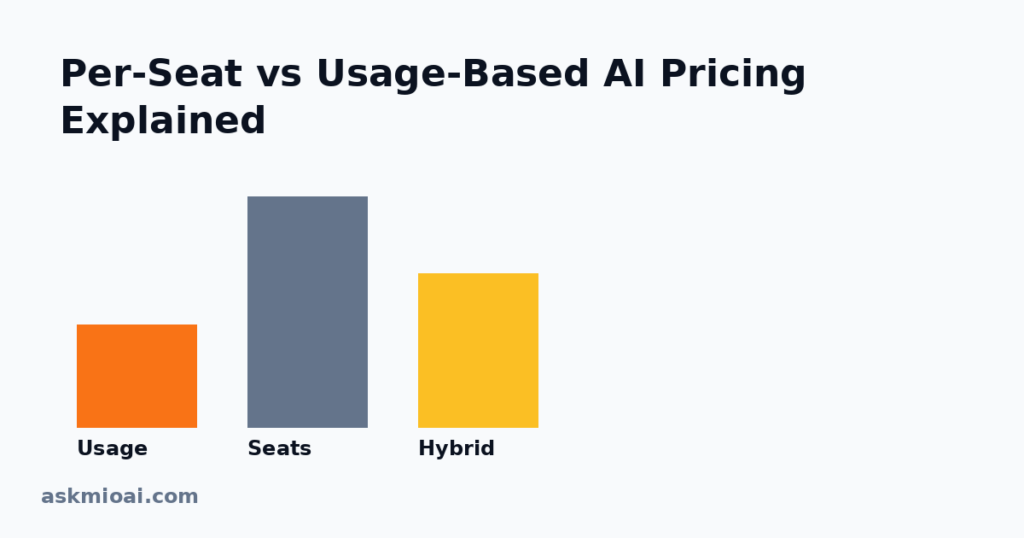
The choice between per-seat vs usage-based AI pricing shapes your bill far more than which specific tool you pick. Per-seat pricing charges a fixed amount for every person with access, whether they use the tool once a week or fifty times a day. Usage-based pricing charges for what actually gets used, however many people touch it. Both are common across AI products, and picking the wrong one for your team’s actual usage pattern can mean paying two or three times what you need to.
How Per-Seat Pricing Works
Per-seat pricing is the model most SaaS tools default to: a flat monthly fee per user, regardless of how heavily each person uses the product. It’s predictable — a 10-person team on a $20-per-seat plan knows the bill is $200 a month, full stop. The downside shows up with uneven usage: if three people on that team use the tool constantly and seven barely touch it, the seven light users are still paying full price, and the team as a whole may be significantly overpaying relative to actual usage.
How Usage-Based Pricing Works
Usage-based pricing charges according to consumption — tokens processed, API calls made, or in Ask Mio’s case, points spent on each request. This aligns cost with actual value delivered: a light user pays little, a heavy user pays more, and nobody subsidizes anyone else’s usage. The tradeoff is predictability — a usage spike (a busy month, a new use case someone starts relying on heavily) can produce a bill that’s harder to forecast than a flat per-seat number, unless the pricing model includes some kind of cap or allowance.
Ask Mio’s Hybrid Approach
Ask Mio actually blends both models rather than picking one extreme. Each plan includes a monthly point allowance (usage-based, so you’re not paying per seat for people who barely use it) plus a per-account subscription fee that scales with plan tier — Free, Chat (€5), Coding (€12), Design (€12), and Business (€29) for teams up to 50 seats. Within the Business plan, the point allowance is shared across the team rather than allocated per person, which means a team with uneven usage doesn’t waste money the way a strict per-seat model would. See the full pricing breakdown for exact allowances per tier.
Which Model Fits Which Team
Per-seat pricing tends to work better when usage is genuinely even across a team — everyone uses the tool roughly the same amount, so a flat per-person fee is close to fair and easy to budget. It also tends to win when the vendor’s usage-based alternative has unpredictable spikes with no cap, since a surprise bill is worse for most budgets than a slightly higher flat fee. Usage-based (or shared-pool) pricing tends to win when usage is uneven — a few power users and many occasional users — or when the team is small enough that per-seat minimums feel wasteful relative to actual need. Freelancers and small teams especially benefit from usage-based models, since there’s no seat minimum forcing them to pay for capacity they don’t need.
The Hidden Cost of Per-Seat: Unused Seats
A cost that rarely gets mentioned directly: per-seat AI tools accumulate unused seats faster than most software, because AI assistant usage tends to be spikier and more habit-dependent than, say, an email client everyone uses daily by necessity. An employee who tried the tool once during onboarding and never returned is still a full-price seat every month until someone notices and removes it. Usage-based or shared-pool pricing doesn’t have this failure mode — an unused account simply doesn’t draw down the point allowance, so idle seats cost the team nothing rather than a silent monthly leak.
Calculating Which Costs Less for Your Team
A rough way to compare: estimate your team’s actual usage volume (chat replies, coding answers, images generated per month) under a usage-based plan’s per-action pricing, and compare that total against what a per-seat plan would charge for the same headcount. If the usage-based total comes in meaningfully lower than the per-seat total, usage pricing wins for your team; if usage is heavy and consistent across nearly everyone, per-seat might actually work out cheaper or at least more predictable. Redo this calculation every few months as team size and usage patterns change — the right model for a 5-person team six months ago might not be right for a 15-person team today.
| Factor | Per-Seat | Usage-Based |
|---|---|---|
| Predictability | High | Lower, unless capped |
| Fairness for uneven usage | Low | High |
| Risk of paying for unused seats | High | None |
| Best for even, heavy usage | Yes | Can be more expensive |
| Best for light or spiky usage | Overpays | Yes |
| Ask Mio’s model | Per-account fee | Points, shared pool on Business |
A Worked Example
Consider a 12-person marketing agency evaluating two AI assistants. Vendor A charges $25 per seat per month, flat, regardless of usage — that’s $300 a month for the team no matter what. Vendor B (usage-based, similar to Ask Mio’s model) charges a smaller per-account base fee plus consumption, and after tracking actual usage for a month, the agency finds four people use it heavily (drafting client copy daily), five use it occasionally (a few times a week), and three barely touch it (once or twice a month, mostly out of habit from onboarding). Under Vendor A’s model, all twelve pay the same $25, meaning the three light users are effectively subsidized by nobody — the agency is just paying $75 a month for near-zero usage from those three seats. Under Vendor B’s usage-based model, the agency’s total bill reflects what was actually used: the heavy users cost more individually, but the light users cost almost nothing, and the team’s total spend tracks its actual AI usage far more closely than a flat per-seat number ever could. This is the core argument for usage-based pricing in almost any team with uneven adoption, which describes most teams in the first six months after rolling out a new AI tool.
Watching Out for Hidden Usage Caps
Some “usage-based” AI pricing isn’t purely usage-based in practice — it comes with a hard monthly or hourly cap, after which the service throttles or blocks further use regardless of whether you’d pay more for it. Ask Mio’s plans work this way too: each tier includes a monthly point allowance plus a 5-hour rolling window limit, and once either is hit, usage pauses until the window resets or you buy a top-up pack. Understanding these caps before committing matters, since a team that regularly hits a low-tier cap might actually be better served by the next plan up rather than staying on a cheaper tier and running into limits mid-month.
How Other Categories of Software Handle This Tradeoff
This isn’t a new problem invented by AI pricing — cloud infrastructure went through the same debate years ago, settling largely on usage-based pricing (pay for compute and storage actually consumed) precisely because workloads are so uneven across customers. Communication tools like phone systems have long offered both a flat per-line model and a pay-per-minute model for the same underlying reason: some customers use a line constantly, others barely touch it, and forcing everyone into one pricing shape either overcharges light users or undercharges heavy ones. AI assistant pricing is following a similar arc, with most vendors now offering some blend rather than a single, rigid seat count — which is a sign the market has learned that AI usage, like cloud compute, tends to be spikier and more unevenly distributed across a team than traditional software.
Negotiating or Choosing a Plan When You’re Between Tiers
Teams often land between two plan tiers — too big for the lower one’s allowance, not quite needing everything the higher tier unlocks. In that situation, it’s worth actually tracking usage for two to four weeks on the current plan before upgrading, rather than guessing. Ask Mio’s account dashboard shows points consumed, which makes this concrete: if a team is consistently using 80% of its monthly allowance with three days left before renewal, that’s a clear signal to move up a tier before hitting a hard stop mid-project. Conversely, if usage sits comfortably under 50% of the allowance most months, a lower tier or fewer paid seats might be the better call, and it’s worth checking that before renewing automatically.
For teams evaluating multiple AI tools side by side, the fairest comparison isn’t listed price alone — it’s projected monthly cost at your team’s actual expected usage, including the realistic risk of hitting a cap and needing a top-up. A tool that looks cheaper on a pricing page can end up costing more once overage fees or forced upgrades are factored in, and vice versa.
Frequently Asked Questions
Which is cheaper, per-seat or usage-based AI pricing?
It depends entirely on your usage pattern. Usage-based is typically cheaper for small or uneven-usage teams; per-seat can be cheaper or more predictable for teams with consistently heavy, even usage across everyone.
Does Ask Mio charge per seat?
Ask Mio charges a per-account subscription fee by plan tier, plus a shared points allowance for actual usage. The Business plan pools points across up to 50 seats rather than allocating a fixed amount per person.
What happens if my team runs out of points mid-month?
You can purchase a top-up pack (starting at €5 for 700 points), which applies immediately and isn’t limited by the 5-hour rolling window, valid for 30 days.
Is usage-based pricing riskier for budgeting?
It can be if there’s no cap, since usage spikes are harder to predict than a flat fee. Ask Mio’s monthly allowances and 5-hour windows act as a soft cap, keeping bills predictable while still reflecting actual usage.
How do I know which pricing model fits my team?
Estimate your team’s actual monthly usage volume and compare it against both pricing structures. If usage is uneven across team members, usage-based or shared-pool pricing almost always comes out ahead.
Do unused seats cost money under usage-based pricing?
No — an account that doesn’t use the service doesn’t draw down the shared point allowance, unlike per-seat pricing where an idle account still costs the full seat price every month.
Can pricing models change as my team grows?
Yes, and it’s worth revisiting periodically. A model that fit a 5-person team may not fit the same team at 15 people, especially if usage patterns shift from even to spiky or vice versa.
The Bottom Line
Per-seat pricing is predictable but punishes uneven usage; usage-based pricing is fairer but needs a cap to stay predictable. Ask Mio’s hybrid model — a plan fee plus a shared, capped point allowance — is built to avoid the worst failure mode of each: no silent unused-seat cost, and no unbounded surprise bill. Compare your team’s real usage against the plans to see which tier actually fits.