
 Lietuviškai
 Deutsch
 Français
 Русский
 Español
 Polski
 Italiano
 Українська
 Čeština
 Português
 日本語
 Latviešu valoda
 Eesti
 Magyar
 Bahasa Indonesia
 Türkçe
 हिन्दी
 Ελληνικά
 العربية
 ไทย
 Tiếng Việt
 Română
 Bahasa Melayu
 বাংলা
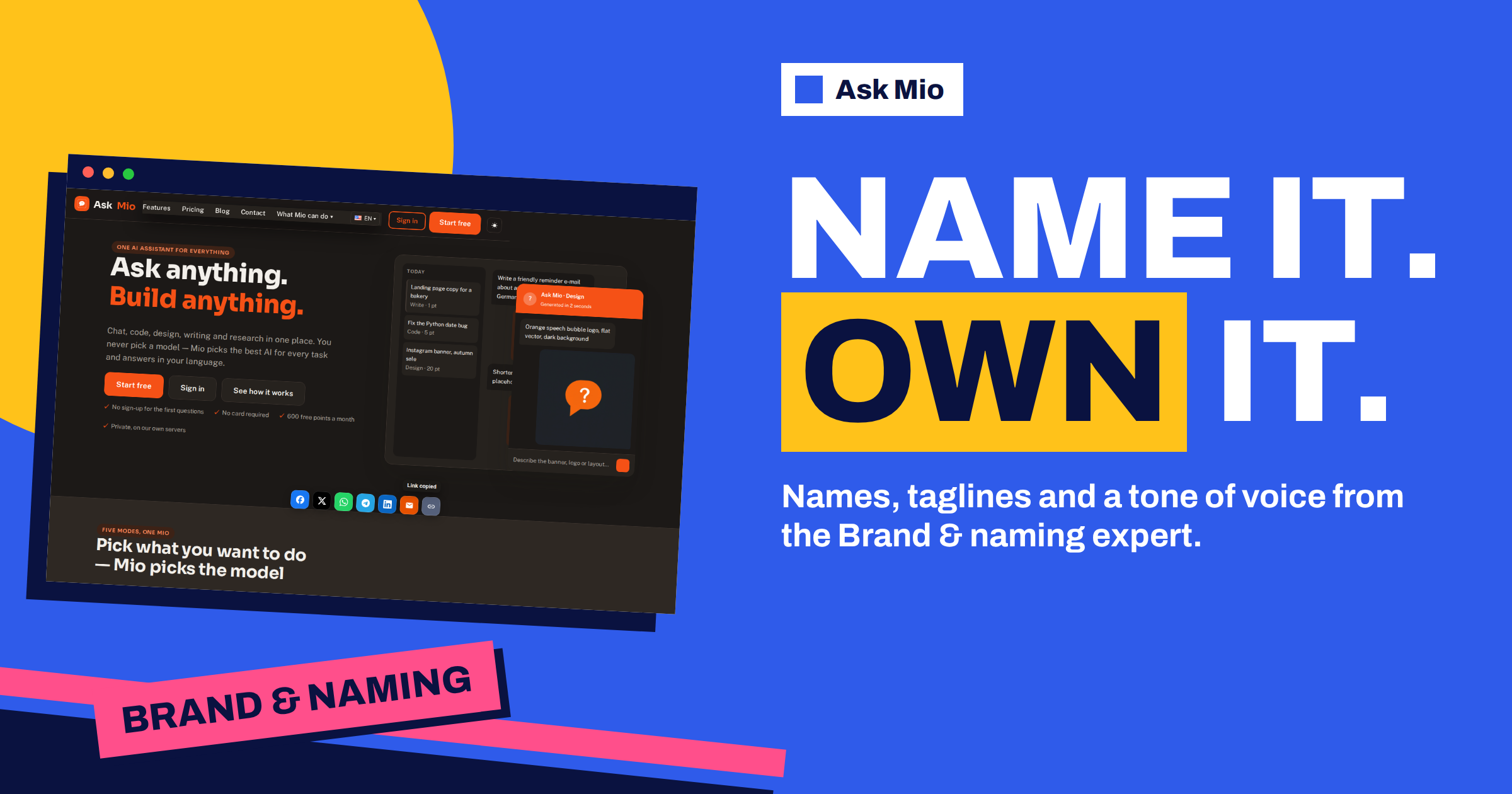
Choosing a name is one of the few business decisions that is hard to undo. A weak name costs you every time someone mishears it, misspells it or forgets it. AI brand naming helps because it can produce a hundred candidates in a minute, but the real value is in what you do after the list appears: filtering, testing and checking. In Ask Mio the job belongs to the Brand and naming expert, which the features page describes as names, taglines, tone of voice and brand stories.
This guide shows a complete workflow. You will learn how to brief the expert, which kinds of names to ask for, how to test a shortlist, what Mio can and cannot check about domains and trademarks, how to write a tagline and how to describe a tone of voice so that every text sounds like one company.
What AI brand naming does in Ask Mio
Ask Mio has 39 experts, and Brand and naming is the one for identity work. When you choose it, Mio keeps that role for the whole chat, so you can move from names to taglines to a short brand story without repeating the background. It works well with the Marketing strategist, who sets positioning, and the Copywriter, who writes the pages. Our overview of AI assistant experts explains how to switch roles inside one conversation.
A name is a short text with a big job. It should be easy to say, easy to spell, different from competitors and suited to what you do and to the customers you want. Brand names range from plain descriptions to invented words, and each type has strengths and risks. The expert can generate all of them, but you decide which fits.
Write a naming brief
The first message decides the quality of the list. Give the expert the following.
- What you do and for whom: one paragraph, no jargon.
- What the name must feel like: trusted, playful, premium, local, technical. Choose two.
- Where it will be used: a shop sign, an app, a website, spoken on the phone.
- Languages and markets: a name that works in one country may mean something else in another.
- Names you like and dislike: with a reason for each.
- Hard limits: length, letters to avoid, words that are already taken by competitors.
Ask Mio to restate the brief in five lines and point out any contradiction, for example “premium” and “cheap and cheerful”. Fix the brief first. Every minute you spend here saves ten later.
Ask for different kinds of names
Do not ask for “good names”. Ask for categories, so the list has range.
| Type | Idea | Strength | Risk |
|---|---|---|---|
| Descriptive | Says what you do | Instantly clear | Hard to own, often taken |
| Invented | A new word | Distinctive, easy to protect | Needs marketing to explain |
| Metaphor | Borrowed image | Memorable, emotional | May confuse the category |
| Compound | Two words joined | Flexible, easy to build on | Easy to copy |
| Founder or place | A name or location | Personal, local trust | Limits growth |
Request fifteen names per type, with one line of reasoning for each. Then ask the expert to remove anything difficult to spell after one hearing, anything that looks like another well-known brand and anything that is awkward in the languages of your markets. Mio answers in your language and handles many languages, so you can ask it to flag meanings in the languages that matter to you. Treat that check as a first filter, not as proof, and ask a native speaker about the final two or three.
Test the shortlist
Pick five to eight names and run them through simple tests. Ask the expert to build a table with the results, then add your own judgment.
- The phone test. Say the name aloud to a friend and ask them to write it down. If they misspell it, customers will too.
- The sentence test. Put the name into three sentences: “I work with ___”, “Have you tried ___?” and “Please email ___”. Does it sound natural?
- The search test. Search for the name with your category. If the first page is full of unrelated results or competitors, visibility will be harder.
- The shortness test. Short names fit signs, icons and mobile screens, but a short name that is too generic will be hard to rank for.
- The growth test. Will the name still fit if you add a product, a service or a country?
Mio has a Web search tool and a Web page reader, so you can ask it to look up each candidate and summarise who uses it. Check the results yourself, as search results change quickly.
Avoid the usual traps while you test. Do not fall in love with a name before the checks are done, because attachment makes you ignore warning signs. Do not pick a name that depends on a pun only you understand. Do not copy the pattern of a famous brand in your field, since it makes you look like a follower and invites confusion. And do not ask only people who already know your business: a stranger’s first reaction is worth more than a friend’s polite approval. Ask three strangers to say what they think the company does from the name alone. If two of the three are far off, consider whether the tagline will carry the meaning or the name needs to change.
What Mio can check about domains and handles
The features page lists a Domain and DNS check tool: it checks a domain’s A, AAAA, MX, TXT and NS records and whether the site responds. That helps with one thing. If a domain returns records and a working site, it is clearly in use. But it does not tell you whether a domain is free to register. A domain with no records can still be registered, parked or reserved.
So use Mio to filter quickly and a registrar to confirm. Check the exact domain you want, plus the main variants, and check the handle on the social networks you plan to use. Prefer a name that is available in the same spelling everywhere, because inconsistent handles confuse customers. Our guide on the domain and DNS checker shows what the tool returns and how to read it.
Trademarks: a warning, not a service
A good-looking name can still be a legal problem. Before you invest in a sign, a logo or a printed range, search the trademark registers for your country and for the markets that matter, in the classes that cover your products. Trademark rules differ between countries, and similar names in related fields can cause disputes even if they are not identical.
Mio can help you prepare: list the classes you think apply, draft questions for a trademark attorney and summarise a register search you paste. It cannot clear a name legally, and it should not be treated as legal advice. For a name that matters, pay for a professional check before you commit.
Taglines that say one thing
A tagline is a short phrase that sits next to the name and sharpens the promise. It should say one thing and say it in plain words. Ask the expert for twenty taglines in four styles: benefit (“Invoices done in minutes”), proof (“Trusted by 300 local shops”), promise (“Fixed price, no surprises”) and attitude (“Small team, big care”). Only use proof you really have.
Edit hard. Remove empty words such as “innovative” and “solutions”, and cut anything that fits every company. Read the shortlist beside the name: they should work as a pair. A strong name with a vague tagline wastes a chance, and a clever tagline can make a weak name feel worse.
Describe the tone of voice
A tone of voice is a short guide that keeps every text consistent: emails, social posts, packaging and support replies. Ask Mio to write one from three inputs: your values, your customers and a few examples of text you like. A useful guide has five parts: three adjectives with a “this, not that” example for each, words you use, words you avoid, rules for greeting and closing, and sample answers to common situations such as a late delivery.
Save it where you can reuse it. On paid plans, memory lets Mio keep the guide so new chats start with it. Our brand voice guide goes deeper, and the article on consistent brand images shows how to keep visuals in line with the words.
A short brand story
People remember stories better than slogans. Ask for a story in three paragraphs: the problem you saw, what you built and what you promise now. Keep it true. Replace invented drama with a real detail, such as the day a customer asked for something you could not do. Then ask for two versions, one of fifty words for a website footer and one of two hundred for an “about” page. Finally, ask Mio to read the story back as a sceptical customer and list every sentence that sounds like marketing instead of fact. Rewrite those sentences with a number, a date or a name. The result is shorter, more believable and easier to repeat when a customer tells a friend what your company does and why it exists.
A worked example: a mobile bike repair service
A mechanic is launching a service that repairs bikes at customers’ homes. He selects the Brand and naming expert and writes a brief: friendly, reliable, local, a name that sounds good on the phone and fits a van. Mio returns seventy-five names across five types. He drops twenty that are hard to spell and twelve that look like existing shops, then tests the last eight by saying them to friends.
Two survive: a short invented word and a compound that says “wheels” and “home”. He uses the domain tool to see that the first has a working site elsewhere, so he picks the second, checks a registrar, finds the domain free and searches the trademark register in his country. Then he asks for taglines, chooses “We come to your wheels” and uses the tone of voice guide to write the first three replies on his website. The whole process takes two evenings.
Frequently Asked Questions
What does the Brand and naming expert do in Ask Mio?
The features page describes it as names, taglines, tone of voice and brand stories. You give it a brief, and it generates name options in several styles, taglines, a tone of voice guide and a short story. Mio keeps the role for the whole chat.
Can Mio tell me if a domain name is available?
Not reliably. The Domain and DNS check tool reads a domain’s records and whether the site responds, which shows when a domain is in use. A domain without records may still be registered, so confirm availability with a registrar before you commit.
Can AI check trademarks?
It can help you prepare, for example by listing classes and drafting questions, but it cannot clear a name legally. Search the trademark registers yourself and ask a professional for any name that matters, especially if you plan to invest in signage or packaging.
How many names should I ask for?
Ask for fifty or more across different types, then filter hard. A long list gives you range, and the filters for spelling, meaning, similarity and availability reduce it to a handful. Choose between the last five using real people, and write down why you chose the winner.
Does the free plan include this expert?
Chat and Write modes are included on the free plan with 600 points a month, and a normal reply costs 1 point. Paid plans add memory, files and research, which help when you want to store a tone of voice guide or analyse competitor sites.
The Bottom Line
AI brand naming works best as a funnel: a clear brief, a wide list in several styles, hard filters, tests with real people, domain and trademark checks, then a tagline and a tone of voice. Use the Brand and naming expert in Ask Mio to do the heavy lifting, and keep the final decision and the legal check in human hands. Start free and compare plans on the Ask Mio pricing page.