
 Lietuviškai
 Deutsch
 Français
 Русский
 Español
 Polski
 Italiano
 Українська
 Čeština
 Português
 日本語
 Latviešu valoda
 Eesti
 Magyar
 Bahasa Indonesia
 Türkçe
 हिन्दी
 Ελληνικά
 العربية
 ไทย
 Tiếng Việt
 Română
 Bahasa Melayu
 বাংলা
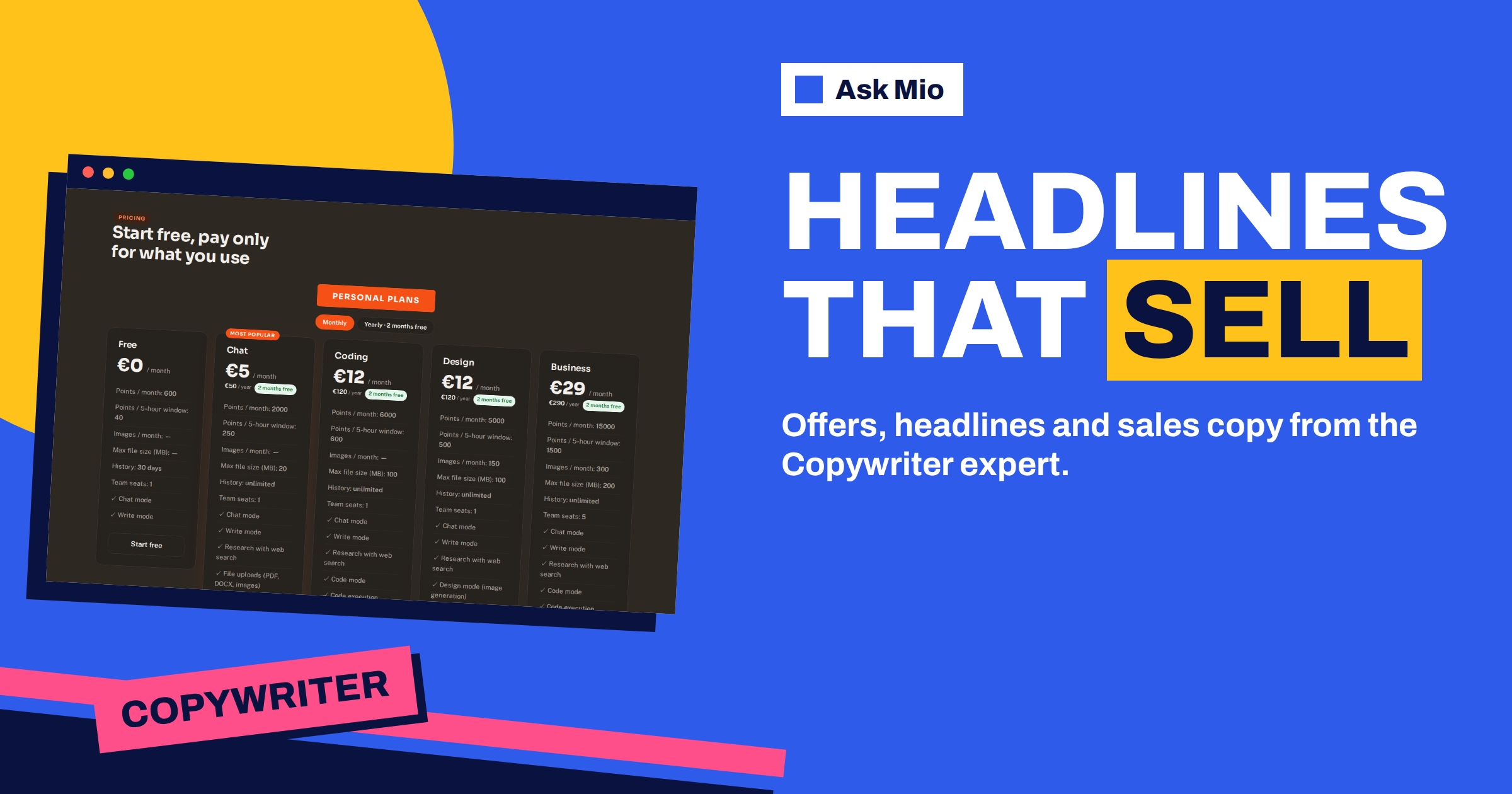
An AI copywriter is only as good as the brief you give it. Ask for “a catchy headline for my product” and you get ten interchangeable lines that could belong to anyone. Give it the offer, the reader, the proof and the one action you want, and the same tool produces copy you can actually use. In Ask Mio this job belongs to the Copywriter expert, which the features page describes as sales copy, headlines and landing pages that convert.
This guide shows how to work with that expert from first brief to final edit. You will learn what to put in the brief, how to generate and choose headlines, how to build a landing page and an email around one offer, how to keep claims truthful and how to test what you publish.
What the AI copywriter expert does in Ask Mio
Ask Mio has 39 experts, and the Copywriter is one of the six shown on the home page. When you choose an expert, Mio keeps that role for the whole chat, so you do not have to repeat “act as a copywriter” in every message. It sits next to related experts: the Marketing strategist for positioning and funnels, the SEO specialist for keywords and content plans, and the Social media manager for platform posts. Our overview of AI assistant experts explains how roles work and when to switch.
Copywriting itself, as Wikipedia defines it, is writing text for the purpose of advertising or marketing. The job is persuasion with a purpose: a reader should understand an offer quickly and take one step. The expert can write that text in 25 languages and more, since Mio answers in your language, and it uses Write mode, where you can set tone and length.
Write the brief before the copy
Most weak AI copy comes from a weak brief. A good brief fits in ten lines and answers questions a human copywriter would ask in the first meeting.
- Offer: what exactly is sold, at what price, with what terms.
- Reader: who they are, what they already tried, what worries them.
- Problem: the situation that makes them look for a solution.
- Proof: numbers, testimonials, guarantees, years in business. Only real ones.
- Action: one step, such as “book a call” or “start the free trial”.
- Tone: formal, friendly, direct, playful. Paste a paragraph of your own writing if you can.
- Limits: words to avoid, claims you cannot make, legal lines that must appear.
Paste the brief once and tell Mio to keep it for the chat. On paid plans you can also store the stable parts, such as your tone and banned words, in memory, so the next project starts faster. Our brand voice guide explains how to describe a voice so that it survives from chat to chat.
Headlines: write many, choose few
A headline has one job: earn the next sentence. The fastest way to a good one is volume followed by judgment. Ask for twenty options in five different angles, then pick three and refine them yourself.
| Angle | What it promises | Example pattern |
|---|---|---|
| Benefit | The result the reader wants | “Fewer late invoices, starting this month” |
| Problem | The pain they know | “Still chasing payments by hand?” |
| Number | A concrete, checkable detail | “Five checks before every delivery” |
| Question | A doubt they already have | “Is your quote too long to read?” |
| How-to | A promise to teach | “How to answer a complaint in four lines” |
Ask Mio to label each headline with its angle, and to avoid claims you cannot support. Then read the list aloud. Cut anything vague, such as “unlock your potential”, and anything that sounds like every other advertisement. A good test is to cover your brand name: if a competitor could use the headline unchanged, it is not specific enough.
Frameworks that give the copy a spine
Frameworks stop a draft from wandering. Three are worth knowing, and you can name them in the prompt.
Problem, agitate, solve. State the problem, make the cost of ignoring it clear, then present the offer. It suits emails and short landing pages.
Before, after, bridge. Describe life now, describe life with the problem solved, then show the product as the bridge. It suits service pages and video scripts.
Attention, interest, desire, action. The classic AIDA model moves a reader from noticing to acting. It suits long pages and ads.
Tell the expert which one to use and ask it to mark the sections, so you can see how the text is built. Then change the order if your reader needs proof earlier than the framework suggests.
Build a landing page around one offer
A landing page should do one thing. The expert can draft every block if you ask in order: the headline and subheading, three benefits written as outcomes, a short “how it works” in three steps, proof, objections answered in a few lines and one call to action repeated at the top and bottom. Mio also has a ready-made job for this, Website page copy, which returns a hero section, benefits, FAQ and call to action from a short form. Our guide to AI landing page copy walks through that route.
After the first draft, ask for a “skim test”: Mio should list what a reader sees in five seconds from headings alone. If the list does not tell the story of the offer, rewrite the headings first. Most readers never go further.
Emails and ads from the same brief
Once the brief exists, a sequence is cheap to produce. Ask for a three-email series: a first email that names the problem, a second that shows proof, a third that makes a clear offer with a deadline that is real. Ask for five subject lines per email and choose the one that is clear rather than clever. For cold outreach, keep it under 120 words and make one request.
For paid ads, the Ads (Google or Meta) job writes headlines and descriptions that fit the platform limits, so you do not have to count characters. Our ad copy guide covers testing several variants at once. Whatever the channel, keep the message the same: a reader who sees the ad, the page and the email should recognise one offer.
Keep claims honest
Persuasive copy can still be truthful, and it must be. AI tools are happy to invent numbers, testimonials and awards if you leave a gap. Close the gap in the brief: state that every figure must come from your list, that no testimonial may be invented and that anything uncertain should be marked with a question mark for you to verify.
Then review the draft against the list of proofs. Remove superlatives you cannot prove, such as “the best” or “guaranteed results”. Check legal wording for your market, especially for health, finance and pricing claims. A copywriter, human or AI, drafts; you remain responsible for what you publish.
Edit for voice and rhythm
A first draft from any tool tends to be even in length and tone. You improve it by editing for rhythm: mix short and long sentences, use verbs instead of nouns, cut adverbs and replace abstract words with concrete ones. Ask Mio to do a “tighten pass” that removes 15 percent of the words without losing facts, and a “voice pass” that rewrites only the sentences that do not sound like your sample.
Read the result aloud. If you stumble, the reader will too. For a final check, ask Mio to list every promise the text makes. Each one should be something you can deliver on the day the customer says yes.
A worked example: a bakery’s weekend box
A small bakery wants to sell a weekend breakfast box. The owner selects the Copywriter and pastes a brief: the box costs a fixed price, contains bread, pastries and jam, can be ordered until Thursday evening and is delivered on Saturday morning within the city. The reader is a busy couple who like good bread but dislike queues. The only action is “order by Thursday”.
Mio returns twenty headlines in five angles. The owner picks “Saturday breakfast, delivered before you wake up”, asks for a three-step page and a two-email reminder, and removes one line that promised “the best bread in town”. She adds her real review score and a photo caption. The whole job takes less than an hour, and every claim on the page is something she can stand behind.
Short copy, long copy and everything between
Length should follow the reader’s need, not a habit. A low-risk, low-price offer, such as a free download, needs a short page: headline, three lines and a button. A high-price or high-risk offer, such as a service contract, needs room for proof, objections and detail. Tell the expert how much your reader needs to know before saying yes, and ask for two versions: a 100-word version for social media or an ad, and a 400-word version for the page.
The same rule applies to product descriptions. The Product descriptions job in Mio returns shop-ready text with benefits, specifications and an SEO title, which suits a catalogue. A flagship product deserves a handwritten story on top of that. Use the tool for the repetitive layer and your own voice for the part that makes the brand different.
Common mistakes with AI copy
- Starting without a brief. The output is generic because the input is.
- Accepting the first headline. The best line is usually number eleven or fifteen.
- Letting it invent proof. Fake numbers damage trust and can break advertising rules.
- Writing for everyone. Copy for a single reader converts better than copy for a crowd.
- Skipping the edit. Unedited AI text sounds the same everywhere, and readers notice.
- Testing too many things. Change one element at a time, so you know what worked.
Test and learn
Copy is a hypothesis. Publish two headlines or two subject lines, wait for a meaningful number of visitors and keep the winner. Ask Mio to propose what to test next, based on your results, and to explain the likely reason a variant won. Save winning lines in a note or in Mio’s memory, so the next brief starts from what has proved to work.
Frequently Asked Questions
What does the Copywriter expert in Ask Mio do?
According to the features page, the Copywriter writes sales copy, headlines and landing pages that convert. When you select it, Mio keeps that role for the whole chat, so you can ask for headlines, a page, an email and an ad in one conversation without repeating instructions.
Can Mio write copy in languages other than English?
Yes. Mio answers in your language, and the product and site run in more than 25 languages. Write mode lets you set tone and length. For important campaigns in a language you do not speak, ask a native speaker to read the final text before you publish it.
How do I stop AI copy from sounding generic?
Give it a specific reader, real proof and a sample of your own writing. Ask for twenty headlines in different angles, pick the strongest and edit them yourself. Remove anything a competitor could say unchanged. The more concrete the brief, the less generic the result.
Is it safe to use invented testimonials or numbers?
No. State in the brief that every figure and quote must come from your list, and mark any gap with a question mark. Publishing invented proof can mislead customers and break advertising rules. Mio drafts the text, but you check every claim before it goes live.
Do I need a paid plan to use the Copywriter?
Write mode is included on every plan, including Free, which has 600 points a month. A normal reply costs 1 point and a long one 3. Paid plans add Research, file uploads and memory, which help with larger projects and a consistent voice.
The Bottom Line
A good AI copywriter works from a brief, produces many options and leaves the final judgment to you. Use the Copywriter expert in Ask Mio, give it the offer, the reader and the proof, choose headlines by angle, build one page and one email from the same message and keep every claim truthful. Start on the free plan and see the options on the Ask Mio pricing page.