
 Lietuviškai
 Deutsch
 Français
 Русский
 Español
 Polski
 Italiano
 Українська
 Čeština
 Português
 日本語
 Latviešu valoda
 Eesti
 Magyar
 Bahasa Indonesia
 Türkçe
 हिन्दी
 Ελληνικά
 العربية
 ไทย
 Tiếng Việt
 Română
 Bahasa Melayu
 বাংলা
AI negotiation prep means using an assistant to do the thinking that most people skip before an important conversation: what you actually want, what you can live with, what the other side probably wants, which arguments will land and how you will respond when they push back. Whether you are asking for a raise, renegotiating a supplier contract, pricing a freelance project or buying a car, the outcome is usually decided in the hour of preparation, not in the meeting.
This guide gives a complete preparation method you can run with any assistant, including the prompts to use, the role-play that makes it stick and the mistakes to avoid. Examples use Ask Mio. The assistant cannot know the other party and must not invent facts about them, so the method is built around what you know, what you can verify and what you can only guess.
Why preparation beats improvisation
Most negotiations are lost before they start for predictable reasons: no clear target, no walk-away point, no idea of the other side’s alternatives, and a first offer made under pressure. People who prepare are not cleverer; they simply have fewer surprises. An assistant makes preparation faster and more complete, because it can lay out the structure, ask the questions you forgot and play the other side so you hear their objections before they say them.
The ideas below draw on standard negotiation concepts. The general overview of negotiation gives the background, and the approach known as principled negotiation focuses on interests rather than fixed positions, which is a good default for most everyday deals.
AI negotiation prep: the six-part brief
Give the assistant a written brief with six parts. Writing it is useful on its own, because it forces decisions.
- The situation. Who you are negotiating with, what is on the table and when the decision happens.
- Your interests. Why you want what you want. “A higher salary” is a position. “To cover a higher rent and to be paid in line with the role’s scope” is an interest.
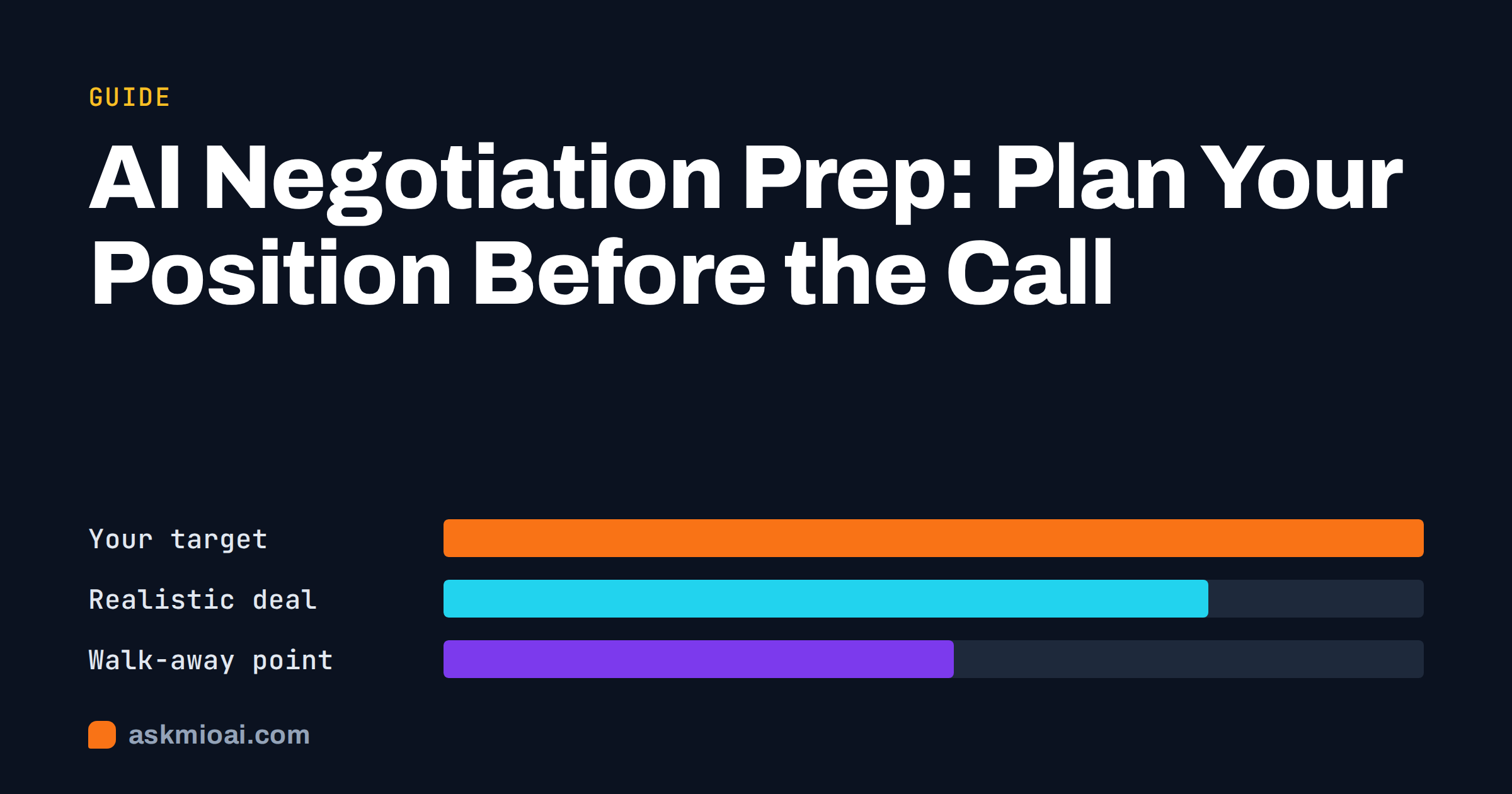
- Your numbers. Your ideal outcome, a realistic target and your walk-away point.
- Your alternatives. What you will do if there is no deal.
- What you know about them. Their goals, constraints and past behaviour, kept separate from guesses.
- Constraints. Deadlines, rules, relationships that must last, things you will not do.
A prompt: “Here is my brief [paste]. First, list what is missing or unclear. Then summarise my position in three sentences, and list the assumptions I am making about the other side. Do not suggest tactics yet.”
Know your three numbers and your alternative
Every preparation needs a target, a floor and a fallback. Many people only have the first.
| Item | Meaning | Common mistake |
|---|---|---|
| Ideal outcome | The best result you could reasonably argue for | Setting it so high it destroys credibility |
| Realistic target | What you expect to land on | Skipping this and aiming at the floor |
| Walk-away point | The worst deal you would still accept | Deciding it during the meeting, under pressure |
| Best alternative | Your best option if no deal happens | Leaving it vague or overestimating it |
The last row is known as the best alternative to a negotiated agreement, often shortened to BATNA. Your walk-away point should come from it. If your best alternative is another job offer, your floor is higher than if it is staying where you are. Ask the assistant to challenge your alternative: “How realistic is this alternative? What would have to be true for it to work, and how long would it take?”
The overlap between what both sides could accept is described in the idea of a zone of possible agreement. You rarely know the other side’s limit, but you can estimate it. Ask Mio to list what the other party’s alternatives probably are, then mark each as a guess.
Understand the other side without inventing them
Assistants are fluent, and that is a risk here: asked about the other party, one may produce confident but invented details about their budget, priorities or tactics. Use it to structure questions, not to supply facts.
- Ask: “List ten questions I should find answers to about the other party before the meeting, and where I could look.”
- Gather facts yourself or with Research mode, which searches the web and cites sources you can check.
- Ask for hypotheses, clearly labelled: “Based only on what I have told you, what might they care about? Mark each as a guess.”
- Separate public information from rumour, and never base a position on something you cannot verify.
For competitive context, such as market prices or benchmarks, see our guide to AI competitor research, and check every number against a source.
Build your case and anticipate objections
Arguments tied to their interests
The strongest arguments speak to what the other side wants. Ask the assistant to turn each of your points into a benefit for them: for a supplier, a longer contract may mean predictable volume; for an employer, a raise may reduce the cost of replacing you. Keep only the arguments that are true.
Evidence
List the facts you can show: results delivered, market data, quotes from other suppliers, past agreements. Ask the assistant to organise them into three or four points, and to flag any claim that needs proof. Do not let it round up your achievements.
Likely objections
Ask for the ten most likely objections, then draft calm, factual responses to the five most serious. Include objections you would rather not hear, such as “we have no budget this year”, and decide in advance what you will say. Having an answer ready is often the difference between holding your position and giving way.
Plan the opening, the first number and the concessions
Three early decisions shape the rest of the conversation.
Who names the first number?
Research on anchoring suggests that the first figure mentioned tends to pull the discussion towards it. If you know the market well, naming a well-supported first number can help. If you know little, you may prefer to hear theirs first. Ask the assistant to lay out the trade-offs for your case, then decide.
The opening statement
Write a short opening of three or four sentences: the purpose, a point of agreement and your first request. Practise it aloud. People who start with something shared, followed by a clear ask, usually get a calmer conversation than those who start with demands.
A concession plan
List what you could give and what you would like in return. Small, cheap-to-you concessions, such as timing or payment terms, can be traded for things that matter more. Plan the order, and decide that every concession is tied to something in exchange. Ask the assistant to produce a table of possible trades, rated by how much each costs you and how much it is worth to them.
Rehearse with role-play
Role-play is where AI is most useful. Ask the assistant to play the other party, with the personality and constraints you describe, and to push back realistically. A prompt: “Play my landlord, who wants to raise rent by 12 per cent. You are polite but firm, and you will not agree to less than 5 per cent. I will begin. After five exchanges, stop and tell me where my arguments were weak.”
Run it several times with different personalities: friendly, rushed, sceptical, aggressive. Then ask for feedback: moments you conceded too early, questions you dodged and phrases that weakened your position, such as “I just think” or “maybe”. Keep in mind that a simulated counterpart is not the real person. It is practice for staying calm and finding words, not a prediction of what they will do. Our guide to AI mock interview practice uses the same technique.
Examples for common situations
Salary and raises
Build your case from results, scope changes and verified market data. Ask for a short script and rehearse. Write down your floor and your alternative, including the option of a non-salary item such as training, flexibility or a review date.
Freelance and client pricing
Prepare a value-based rationale and three packages at different prices. Practise responses to “that is too expensive”. Our guide for AI for freelancers includes related prompts.
Supplier and procurement deals
List your interests beyond price: delivery, quality, payment terms and flexibility. Gather quotes and ask the assistant to compare them in a table. Teams that do this often can use the ideas in AI for procurement teams.
Complaints and refunds
State the facts, what you want and a reasonable deadline, in a calm tone. The guide to the AI complaint letter shows how to write it.
Sales conversations
Prepare responses to discount requests and decide in advance what you can offer instead of a lower price. See AI for sales teams.
Ethics, limits and confidentiality
Good preparation is not manipulation. Use the assistant to understand, plan and communicate clearly, not to invent pressure, fake alternatives or mislead. Lying about a competing offer damages trust and can have legal consequences, and relationships often outlast one deal.
Practical limits to keep in mind:
- Confidentiality. Do not paste confidential contracts, trade secrets or someone else’s private information into a tool you are not allowed to use for them. Describe the situation in general terms where you can.
- Not legal or financial advice. For contracts, employment disputes and large sums, consult a qualified professional.
- Verify numbers. Assistants can state figures confidently and wrongly. Check anything you will quote.
- Cultural differences. Norms around haggling, hierarchy and directness vary. Tell the assistant the context and check with someone who knows it.
After the negotiation
Write down what was agreed immediately, and send a short confirmation message. Ask the assistant to turn your notes into a clear, friendly recap with the agreed points, owners and dates. Then do a brief review: what worked, what surprised you, what you would prepare differently. Save the notes in an Ask Mio project so your next negotiation starts from experience rather than from scratch.
Cost and plan notes
Preparation and role-play are Chat tasks. Ask Mio’s pricing page lists a normal chat reply at 1 point and a longer one at 3, and the free plan includes 600 points a month with Chat and Write. Research mode, which searches the web and cites sources for market facts, comes with paid plans from €5 a month, as do file uploads for analysing a draft contract you are allowed to share.
Frequently Asked Questions
Can AI really help me negotiate better?
Yes, mainly through preparation and practice. It helps you clarify interests, set a target and walk-away point, anticipate objections and rehearse with role-play. It cannot know the other party or guarantee a result, and it can invent facts, so supply real information and verify any figures you plan to use.
What is a walk-away point and how do I set it?
It is the worst deal you would still accept, based on your best alternative if no deal happens. Decide it before the meeting, write it down and ask the assistant to test how realistic your alternative is. Setting it under pressure during the conversation usually leads to a worse outcome.
Should I share confidential documents with the assistant?
Only if you are permitted to and trust the tool. Contracts and internal figures often carry confidentiality duties. Describe the situation in general terms, remove names and numbers where possible, and check your organisation’s policy. For legal documents of real consequence, use a qualified professional.
How do I use role-play without fooling myself?
Give the simulated counterpart a clear personality and limits, run it several times with different styles and ask for feedback on your weak moments. Treat it as practice for staying calm and finding words, not a forecast. The real person will behave differently, so keep your plan flexible.
Is it unethical to use AI to prepare for a negotiation?
No, preparation is normal and sensible. It becomes a problem if you use it to deceive, such as inventing a competing offer or misrepresenting facts. Use it to understand both sides, communicate clearly and find agreements that work, and keep every claim you make true.
Which plan do I need?
The free plan covers Chat and Write, which is enough for briefs, objection lists and role-play. Research with cited web sources and file uploads need a paid plan from €5 a month. The current plans are always on the pricing page rather than in this article.
The Bottom Line
AI negotiation prep is a structured way to decide what you want, know your floor and your alternative, anticipate objections and rehearse before you sit down. Write the six-part brief, label guesses as guesses, verify every number and run the role-play more than once. Start with the free plan for your next real conversation, and compare Research mode and file uploads on the Ask Mio pricing page.