
 Lietuviškai
 Deutsch
 Français
 Русский
 Español
 Polski
 Italiano
 Українська
 Čeština
 Português
 日本語
 Latviešu valoda
 Eesti
 Magyar
 Bahasa Indonesia
 Türkçe
 हिन्दी
 Ελληνικά
 العربية
 ไทย
 Tiếng Việt
 Română
 Bahasa Melayu
 বাংলা
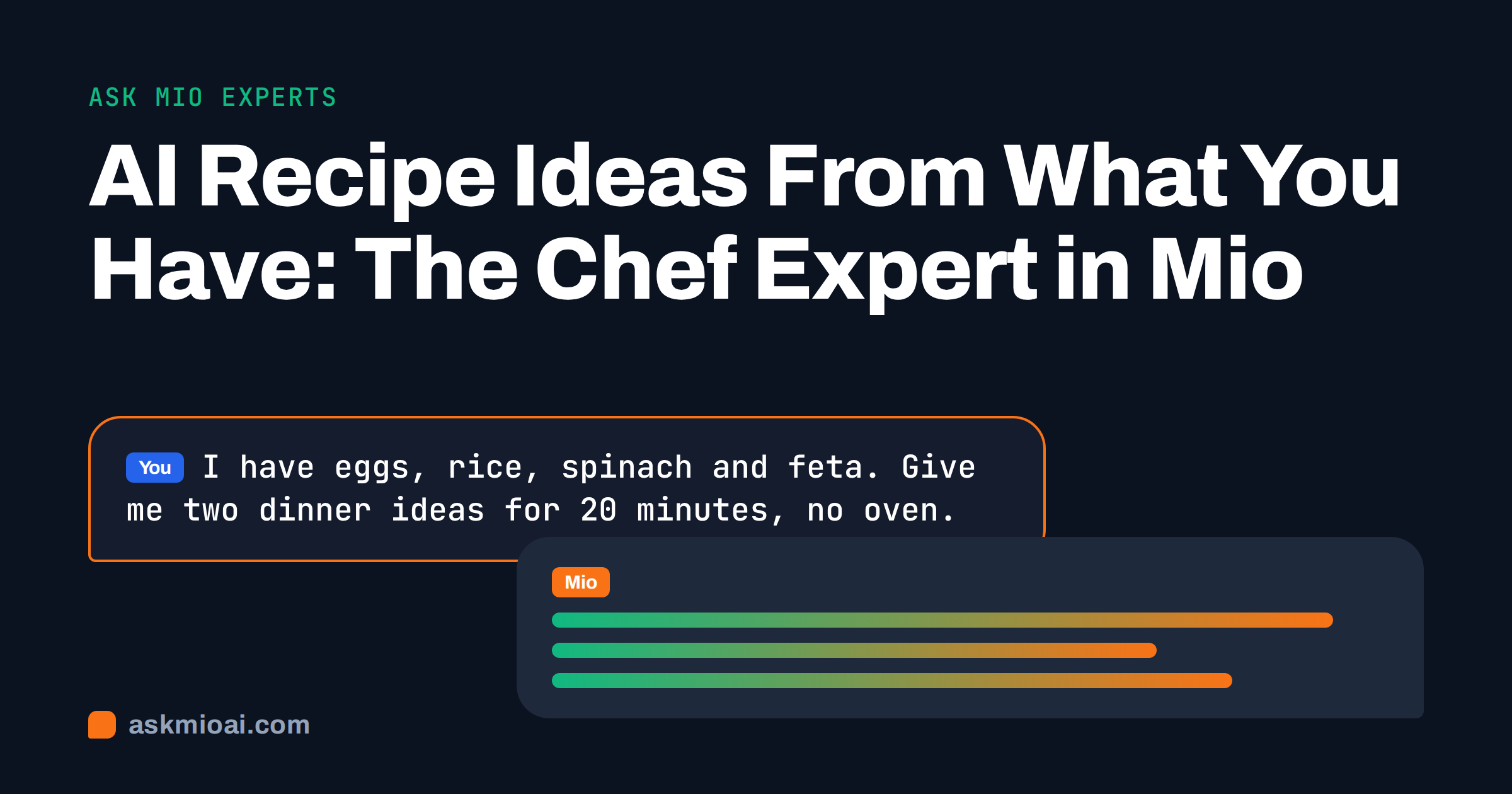
AI recipe ideas are most useful at the moment you open the fridge and have no plan. You have eggs, rice, a bag of spinach and half a block of feta, it is six in the evening and nobody wants to shop. An assistant can turn that list into two or three realistic dinners, tell you the order of steps, scale the quantities for the people at the table and write the shopping list for whatever is missing. Ask Mio has a Chef expert for this: the features page describes it as recipes from what you have, menus and techniques. When you choose it, Mio keeps that role for the whole chat.
This guide shows how to get good recipe ideas from the Chef expert. It covers how to describe your ingredients, time and equipment, how to handle diets and allergies, how to scale and convert quantities exactly, how to plan a week of meals, how to learn techniques, how to reduce waste, food safety and a worked example. The goal is dinners you can cook tonight and trust.
What the Chef expert in Mio does
The Ask Mio features page lists 39 experts that turn Mio into a specialist for the whole chat. The Chef is described as recipes from what you have, menus and techniques. Next to it are the Nutrition helper, described as meal plans, calories and shopping lists, and a ready-made job for a weekly menu with a shopping list and calories. Between them they cover the ordinary cycle of home cooking: decide, shop, cook, repeat. Our overview of AI assistant experts explains how roles work, and the guide to the AI meal planner covers weekly planning in more depth.
- Recipes from what you have: start from your ingredients, not from a recipe book.
- Menus: combine dishes into a coherent meal or a week.
- Techniques: learn how to sear, braise, fold, rest or scale a recipe.
How to get AI recipe ideas from what you have
A good request is specific about ingredients and honest about constraints. List what you have, with rough amounts, and add the time you have, the equipment and the number of people. Mention what you do not want to buy, and any strong likes or dislikes.
- Ingredients: “four eggs, a cup of cooked rice, a bag of spinach, 100 g feta, an onion, olive oil”.
- Staples: say whether you have salt, pepper, oil, flour, spices and stock.
- Time: “20 minutes, no oven”.
- People: two adults and a child who dislikes spicy food.
- Output: two ideas, ingredient quantities and numbered steps.
Example prompt: “I have eggs, rice, spinach and feta. Give me two dinner ideas for 20 minutes, no oven, for two adults. Use only what I listed plus oil and salt, and tell me what I could add if I buy one thing.” The constraint of “only what I listed” keeps the suggestions realistic.
Diets, allergies and preferences
Food preferences range from taste to medical necessity, and the assistant cannot tell which is which unless you say. Mention vegetarian, vegan, halal, kosher, low-sodium, gluten-free or other needs at the start of the chat. For allergies, be explicit about the allergen and the seriousness. Even so, treat the assistant as a source of ideas and not as a safety system: it can overlook a hidden ingredient, such as an allergen in a sauce or a stock cube.
| Need | What to tell the Chef | What you must check |
|---|---|---|
| Allergy | Name the allergen and ask to avoid it entirely | Read every product label yourself |
| Vegetarian or vegan | State the diet and any exceptions | Hidden animal ingredients in stock, sauces and cheese |
| Gluten-free | Ask for naturally gluten-free ideas | Labels on grains, sauces and oats |
| Low salt or sugar | Give your target and ask for substitutions | Advice from your doctor or dietitian |
| Children | Give ages and textures they accept | Choking risks and portion sizes |
| Religious rules | State the rules you follow | Certification and ingredient sourcing |
For medical diets, follow your clinician’s advice. The assistant can help you format a menu and a shopping list around that advice, but it cannot replace it. Our guide to asking AI health questions explains the limits.
Scale quantities and convert units exactly
Scaling is where mental arithmetic often fails. A recipe for four becomes a recipe for seven, or a US recipe in cups must be converted to grams. The features page lists a calculator tool that evaluates arithmetic expressions exactly, and Mio uses its tools by itself while answering. Ask for the scaled ingredients and the working, so you can check the factor you used. Be careful with items that do not scale linearly: spices, salt, baking time, pan size and leavening agents all need judgment.
- “Scale this recipe from 4 to 7 portions and show the multiplier.”
- “Convert these cups and ounces to grams and millilitres, and say which ingredient densities you assumed.”
- “Tell me which items I should scale less than proportionally, and why.”
Our guide to the best AI for maths explains how tools differ in accuracy for calculations like these.
Plan a week and build the shopping list
Once you can cook tonight, plan the week. Give the number of dinners, your budget, the diets at the table and what is already in the pantry. Ask for a menu in which ingredients are reused, such as roasting one tray of vegetables for two meals, so that nothing is left to spoil. The ready-made job on the features page produces a weekly menu with a shopping list and calories, and the Nutrition helper can adjust it to your targets. Read the calorie figures as estimates, because they depend on portion sizes and brands.
- List the dinners you want and any fixed days, such as a quick meal on busy nights.
- Ask for a shopping list grouped by store section.
- Ask which ingredients are shared across meals, to avoid waste.
- Ask for a prep plan: what to chop or cook on Sunday.
- Check prices and substitutions at your own shop.
Learn techniques, not just recipes
A recipe tells you what to do, and a technique tells you why. Ask the Chef to explain how to get a crisp skin, why onions should be cooked slowly, how to tell when a sauce has reduced or how to rest meat. Ask for common mistakes and how to fix them, such as a split sauce or rubbery eggs. Request a short list of five techniques to practise this month, with a simple dish for each. Over time you will need the assistant less, which is the best outcome of learning to cook. For general background, the cooking article gives an overview of methods.
Reduce waste and save money
Ingredient-first cooking naturally reduces waste. Ask for ideas for the last of something: stale bread, a single carrot, leftover rice or herbs that are wilting. Ask for storage tips and for ways to freeze portions. Request a “use it up” list for the items closest to their date, and a small stock of recipes for flexible dishes such as soups, fried rice, frittatas, curries and pasta bakes, in which many ingredients can be swapped. Keep a note of what you often throw away, and ask Mio to suggest smaller purchases or alternatives.
Cooking for different kinds of day
Recipe needs change with the day. On a weeknight you want speed and few dishes, so ask for one-pan or fifteen-minute ideas. At the weekend you may want a slower project, so ask for a menu with timing for a dinner party, working backward from the moment guests sit down. When you are tired or short of money, ask for cheap, filling meals built from pantry staples such as rice, beans, pasta, tinned tomatoes and frozen vegetables. When you cook for a child, ask for versions that can be adapted at the table, such as a deconstructed plate. For batch cooking, ask for recipes that freeze well and instructions for reheating. Each context changes the answer, and the more you tell the Chef about your day, the better the result will be. Keep notes of the dishes your household liked, and paste them into the next chat so that suggestions improve over time.
Food safety basics
An assistant can suggest cooking times and storage advice, but it does not replace food safety guidance. Cook meat, poultry, fish and eggs thoroughly, store leftovers promptly in the fridge or freezer, reheat food until hot throughout, avoid cross-contamination between raw and cooked items and watch dates on packaging. The World Health Organization has a food safety fact sheet with basic principles. When the assistant gives a temperature or a time, compare it with your thermometer, your oven’s behaviour and trusted guidance from your food authority.
A worked example: dinner from four ingredients
With eggs, rice, spinach and feta, Mio’s Chef suggests two dishes. The first is a spinach and feta fried rice with a fried egg on top, ready in about fifteen minutes. The second is a baked-style frittata cooked in a frying pan on the hob, with the rice folded in. For two adults it proposes four eggs and 150 g of cooked rice for the first dish, and asks whether you have garlic or soy sauce to add. You answer that you have garlic only, and it adjusts the steps, adding a note to season carefully because feta is salty. You ask for the quantities for three people, and it shows the multiplier. You cook the first dish, find it needs more seasoning and ask what to do next time. Your feedback improves the next suggestion, and you have a shopping list of three small items to make the dish even better.
Using Mio for cooking
Chat mode is on every plan, including the free plan with 600 points a month, and the pricing page says a normal reply costs 1 point and a long or complex one 3. Paid plans add memory, so Mio can remember your family’s diets and dislikes, and file uploads, so you can share a photo of your fridge or a recipe from a book for scaling. Your chats and files are yours, they are not used to train models and you can export or delete them at any time.
Frequently Asked Questions
What does the Chef expert in Ask Mio do?
According to the features page, it helps with recipes from what you have, menus and techniques. When you choose it, Mio keeps that role for the whole chat, so you can list ingredients, ask for dinner ideas, scale recipes and plan a week without repeating the instructions in every message.
Can AI recipe ideas handle food allergies?
It can avoid an allergen you name and suggest alternatives, but it cannot guarantee safety. Hidden ingredients in sauces, stocks and processed foods are easy to miss. Always read product labels yourself, and follow the advice of your doctor or allergist for serious allergies.
Can Mio scale recipes and convert units?
Yes. Mio can use its calculator tool to evaluate arithmetic exactly, and you can ask it to show the multiplier and the working. Remember that spices, salt, leavening and cooking times do not always scale in proportion, so adjust with judgment and taste as you go.
Are the calorie numbers accurate?
Treat them as estimates. Calories depend on exact ingredients, brands, portion sizes and cooking methods. For medical or sports nutrition goals, use measured data from labels and follow the advice of a qualified professional. The assistant is useful for comparing options and building a rough plan.
Is the free plan enough for meal ideas?
Yes. Chat mode and 600 points a month are plenty for dinner ideas, scaling and shopping lists, since a normal reply costs 1 point. Paid plans add memory for your diets and dislikes and file uploads for recipes and photos, which helps when you cook for the same household every week.
The Bottom Line
AI recipe ideas turn a handful of ingredients into dinners you can cook tonight. Use the Chef expert in Ask Mio, be specific about ingredients, time and diets, let exact calculations scale the quantities, plan the week and check allergies, labels and food safety yourself. Start on the free plan and compare options on the Ask Mio pricing page.