
 Lietuviškai
 Deutsch
 Français
 Русский
 Español
 Polski
 Italiano
 Українська
 Čeština
 Português
 日本語
日本語 Latviešu valoda
 Eesti
Eesti Magyar
 Bahasa Indonesia
 Türkçe
 हिन्दी
 Ελληνικά
 العربية
 ไทย
ไทย Tiếng Việt
 Română
 Bahasa Melayu
 বাংলা
বাংলা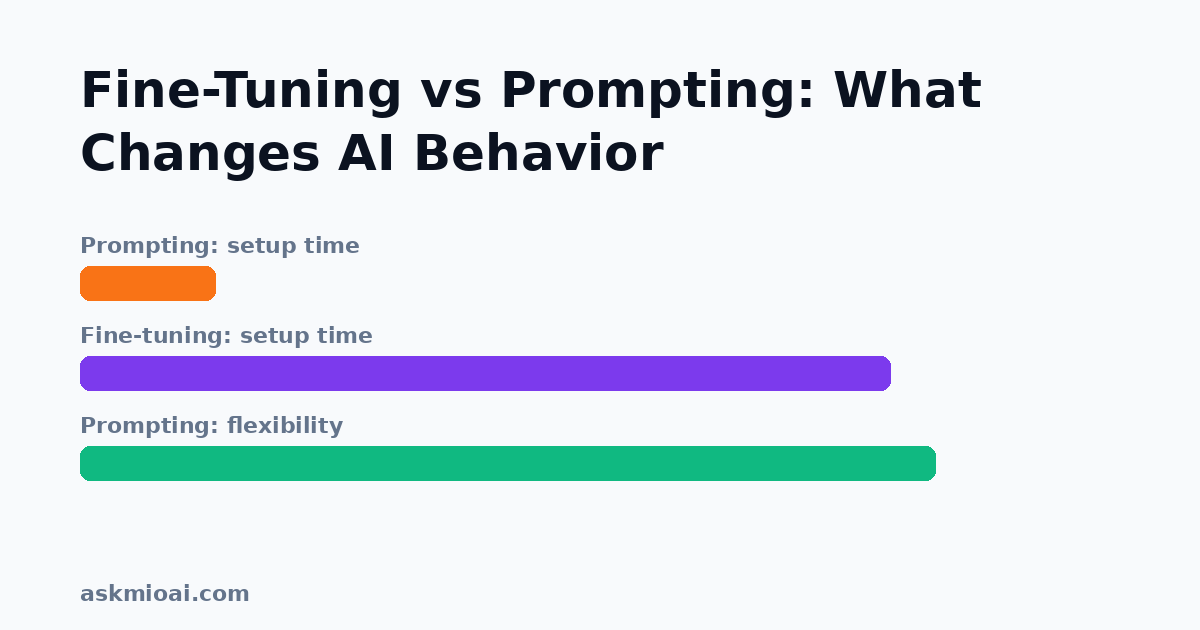
Fine-tuning vs prompting is the question behind a surprising number of AI projects that stall: teams assume they need to fine-tune a model to get consistent, on-brand output, spend weeks preparing training data, and discover afterward that a better-structured prompt would have solved the problem in an afternoon. Here’s what each approach actually changes, when fine-tuning is genuinely worth it, and why most everyday use — including how Ask Mio is built — leans almost entirely on the prompting side.
What Prompting Actually Changes
Prompting means giving a model instructions, context and examples at the moment you ask it something, without altering the model itself. The model’s underlying weights — the billions of learned parameters that determine how it responds — stay exactly as they were before your request. What you’re doing is steering a fixed, general-purpose model toward the specific output you want, using techniques like clear instructions, examples of the desired format, and relevant context pasted directly into the request.
This is why prompting is fast: there is no training step, no data preparation, no waiting for a job to finish. Change the prompt, get a new result immediately. It’s also why prompting has limits — you’re working with the model’s existing knowledge and behavior, not teaching it anything new. If a model consistently misunderstands your domain’s specific terminology no matter how you phrase the request, that’s a sign you’ve hit prompting’s ceiling.
What Fine-Tuning Actually Changes
Fine-tuning means further training an existing model on a specific dataset of examples, which adjusts the model’s actual weights. After fine-tuning, the model itself behaves differently by default, even with a short, generic prompt, because the training process has shifted its internal parameters toward the patterns in your dataset. This is a fundamentally heavier operation: it requires a prepared dataset (often hundreds to thousands of quality examples), compute time to run the training, and typically produces a new model artifact that needs to be hosted and versioned going forward.
The upside is real for the right use case: a fine-tuned model can produce a very specific style, tone, or output format consistently without needing that instruction repeated in every prompt, and it can encode narrow domain knowledge that would otherwise require pasting a long reference document into every request. The costs are also real — data preparation is genuinely labor-intensive, and a model fine-tuned on last year’s data doesn’t automatically know about anything after that, unlike a well-prompted general model paired with fresh, retrievable context.
Side-by-Side Comparison
| Factor | Prompting | Fine-Tuning |
|---|---|---|
| Setup time | Minutes | Days to weeks, depending on data readiness |
| Data required | None beyond the prompt itself | A curated dataset of quality examples |
| Cost pattern | Pay per request, no separate training cost | Upfront training cost plus ongoing hosting of the tuned model |
| Flexibility | Change instructions instantly | Requires retraining to change behavior |
| Best for | Most everyday tasks, evolving requirements, general knowledge questions | Highly repetitive, narrow tasks with a stable, well-defined pattern |
| Keeping up to date | Easy — update the prompt or the context you provide | Requires retraining on new data to reflect new information |
| Typical user | Individuals and teams using an assistant day to day | Companies building a narrow, high-volume automated pipeline |
When Fine-Tuning Is Actually Worth It
Fine-tuning earns its cost in a fairly narrow set of situations: extremely high request volume where a shorter, tuned-behavior prompt saves meaningful money at scale; a very specific, consistent output format that needs to hold up across thousands of automated calls without a person reviewing each one; or domain-specific jargon and patterns so unusual that no amount of in-prompt explanation reliably gets a general model to use them correctly. Companies running a single, narrow, extremely high-volume task — classifying support tickets into a fixed set of categories, for instance — are the classic case where the upfront investment pays off.
Outside those cases, fine-tuning is usually the wrong tool. If your requirements change month to month, if you need the model to reflect current information, or if you’re doing a mix of different tasks rather than one repeated narrow one, you’ll spend more time and money maintaining a fine-tuned model than you would just writing better prompts.
The Underused Middle Ground: Context and Retrieval
Between plain prompting and full fine-tuning sits a middle option that covers far more real use cases than either extreme: giving the model the right context at request time, rather than baking it into the weights. This is what RAG (retrieval-augmented generation) does — pulling in relevant documents or data at the moment of the request, so the model has fresh, specific information without needing to be retrained when that information changes. Ask Mio’s projects and memory features work in this spirit: instructions, files and remembered preferences get supplied as context automatically, giving much of fine-tuning’s consistency benefit — the assistant “knows” your brand voice or your recurring format — without any training step, and updatable the moment your needs change.
Why Ask Mio Leans on Prompting and Routing, Not Fine-Tuning
Ask Mio is built around routing your request to whichever underlying model handles that task best, then relying on well-structured prompting, context and tools to get the specific result you need — not on fine-tuning a model to your account specifically. That’s a deliberate trade-off: it means Mio can route to newer or better-suited models as they become available, rather than being locked to whatever model a fine-tuning process was run against. For the vast majority of everyday requests — writing, coding help, research, image generation — a well-routed, well-prompted general model consistently outperforms the complexity of maintaining a fine-tuned one, especially since your own instructions and files, saved in a project, already deliver much of what a narrow fine-tune would buy you.
A Simple Way to Decide
- If you can solve the problem by writing a clearer prompt or providing better examples, do that first — it’s nearly free and instantly reversible.
- If the issue is missing or outdated information, reach for retrieval or file uploads before fine-tuning — a document given as context solves this without retraining anything.
- Only consider fine-tuning once you have a stable, high-volume, narrowly defined task where the cost of the tuning process is clearly smaller than the cost of repeatedly prompting at scale.
- Re-evaluate a fine-tuned model periodically — if the task or the data it was trained on has shifted, the model needs retraining or it will quietly drift out of date.
A Concrete Example: Customer Support Replies
Imagine a company wants an AI assistant to draft support replies in its specific brand voice, referencing its own product terminology correctly. The fine-tuning approach would mean collecting hundreds of examples of past support replies, cleaning them up, running a training job to produce a custom model, then hosting and maintaining that model going forward — a project measured in weeks, with real engineering time attached, before checking whether it actually produced better replies than the alternative.
The prompting-plus-context approach reaches a similar result far faster: write a clear style guide describing the brand voice, save a handful of example replies as reference, upload the product glossary, and provide all of that as context with each request — exactly what a project in Ask Mio is built to hold persistently, so it doesn’t need re-explaining every time. For the vast majority of companies at this scale, the second approach produces comparably good replies in an afternoon rather than weeks, and it can be edited the moment the brand voice or product line changes, without retraining anything.
Why Teams Often Reach for Fine-Tuning Too Early
Fine-tuning has a certain appeal precisely because it sounds like the “real” technical solution — training your own model feels more serious than writing a better prompt. In practice, this instinct causes teams to skip the much cheaper diagnostic step: actually testing whether a more detailed prompt, better examples, or added context solves the problem first. Because prompting iteration is nearly free, there’s rarely a good reason not to exhaust it before committing to a training pipeline, a labeled dataset, and an ongoing hosting and versioning burden that a fine-tuned model brings with it.
There’s also a compounding cost people underestimate: a fine-tuned model needs to be revisited every time the underlying base model improves, since providers regularly release stronger versions of their general models. Sticking with a fine-tuned model built on last year’s base means missing out on those improvements unless you redo the fine-tuning process against the new base — another training cycle, another round of validation. A prompting-based approach benefits from a better base model immediately, the moment routing picks it up, with zero extra work.
What About Few-Shot Prompting?
Between a plain instruction and full fine-tuning sits few-shot prompting — including a handful of worked examples directly in the prompt to show the model the pattern you want, rather than describing it abstractly. This technique alone resolves a large share of the cases people assume need fine-tuning: showing three examples of the exact output format you want is often enough to get consistent results, without any training step at all. It costs a bit more per request, since those examples take up space in the prompt, but that cost is trivial compared to preparing and maintaining a fine-tuning dataset, and it can be changed instantly if the desired format shifts.
Frequently Asked Questions
What’s the simplest way to explain the difference?
Prompting steers a model’s existing behavior at request time without changing it. Fine-tuning permanently adjusts the model’s internal weights through further training, changing its default behavior even with a short prompt.
Is fine-tuning always better because it’s more advanced?
No. Fine-tuning is worth the cost and maintenance only for narrow, high-volume, stable tasks. For most everyday work, a well-crafted prompt with good context and examples produces comparable or better results at a fraction of the effort.
Does Ask Mio use fine-tuned models for each user?
No. Ask Mio routes requests to the best general model for the task and relies on prompting, context, tools and your saved project instructions to tailor the result, rather than fine-tuning a model per account.
What is RAG and how does it relate to fine-tuning?
RAG (retrieval-augmented generation) supplies relevant documents or data to a model at request time instead of training that knowledge into the model’s weights. It solves the “the model doesn’t know this” problem without the cost and rigidity of fine-tuning.
Can I get fine-tuning-like consistency without actually fine-tuning?
Often yes. Saving your instructions, preferred format and reference files in a project or persistent memory gives an assistant much of the consistency a narrow fine-tune would provide, and it can be updated instantly rather than requiring retraining.
How much data do you need to fine-tune a model?
It varies by provider and technique, but useful fine-tuning generally needs at minimum hundreds of quality, representative examples — a handful of examples is rarely enough to shift a model’s behavior reliably.
Does a fine-tuned model automatically know about recent events?
No. A fine-tuned model’s knowledge is fixed at the point its training data was assembled, just like the base model it started from. Keeping it current requires retraining, whereas a well-prompted model paired with fresh context or web search stays current without retraining.
Tokens, Points and the Cost of Context
Worth noting for anyone comparing the running cost of each approach: heavier prompting — longer instructions, several examples, uploaded reference files — does cost more per request than a short prompt, since it uses more tokens. On Ask Mio’s points system, a longer or more complex reply costs more points than a short one, but that marginal cost is still far below the upfront and ongoing cost of a fine-tuning pipeline for the overwhelming majority of use cases. The break-even point where fine-tuning’s fixed cost beats prompting’s marginal cost only arrives at genuinely high request volumes on a stable, narrow task — which is exactly the case described above where fine-tuning earns its keep.
The Bottom Line
For the overwhelming majority of real work, better prompting plus the right context beats fine-tuning on cost, speed and flexibility — and it’s why Ask Mio invests in routing and context rather than training a model per user. Save fine-tuning for the narrow case where you’re running one stable, high-volume task at a scale where the training investment clearly pays for itself. Try Ask Mio’s free plan and see how far a well-structured prompt and a saved project get you before reaching for anything heavier.