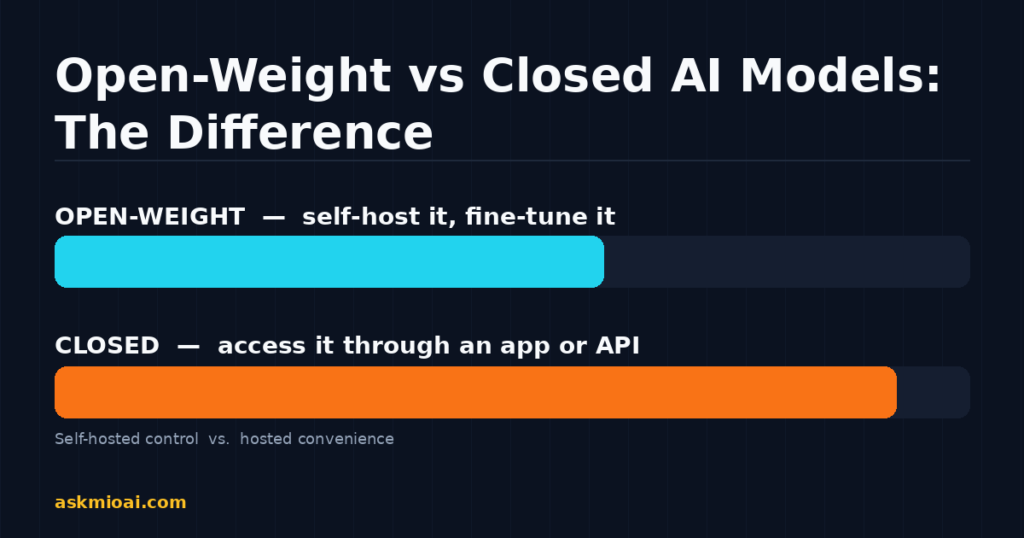
Open-weight vs closed AI models comes down to one question: can you download the model and run it yourself, or can you only reach it through someone else’s app and API? Open-weight models publish their trained parameters for anyone to download, inspect, fine-tune and self-host. Closed models keep those parameters private, so you use them only through the provider’s product or API. Neither approach is universally “better” — they trade control and privacy for convenience and ease of access, and which one fits you depends on what you’re actually trying to do.
This article explains both terms in plain language, walks through real tradeoffs instead of hype, and looks at where a hosted assistant like Ask Mio sits between the two worlds.
What “Open-Weight” Actually Means
A language model, at its core, is a very large file of numbers — the “weights” — learned during training. When a company releases a model as open-weight, it publishes those weight files publicly, usually alongside code for running the model. Anyone with the right hardware (or a rented cloud GPU) can download the weights and run the model on their own machines, without going through the original company’s servers at all.
This is different from “open source” in the strict software sense. Open-weight usually means you get the trained model itself, not necessarily the training data, the training code, or full documentation of how it was built. Some releases include more of that pipeline than others, so the word “open” covers a spectrum rather than one fixed thing.
Examples of Open-Weight Releases
Meta’s Llama family is probably the best-known example of a major lab publishing open-weight models that people can download and run themselves. Mistral has also released open-weight models under its own terms, documented on its official developer docs. DeepSeek is another example of a company that has published open-weight releases. These are mentioned here purely as examples of what an open-weight release looks like in practice — not as a ranking, and not as a claim about which one performs best on any given benchmark, since that changes constantly as new versions ship.
It’s worth being precise about licensing too. Open-weight licenses vary a lot from one release to the next: some are genuinely permissive, some restrict commercial use above a certain company size, some require attribution, and some limit what you can build on top of the model. Hugging Face keeps a plain-language reference on model licenses that’s a useful starting point. If you’re planning to self-host a specific model for a real project, read that model’s actual license text before you commit — don’t assume all open-weight models share the same terms just because they’re all called “open.”
What “Closed” or Proprietary Means
A closed model is the opposite arrangement. The company that trains it keeps the weights on its own servers and never publishes them. You interact with the model only through a hosted product, a chat interface, or an API call that sends your request to their infrastructure and returns a response. You never possess the model itself, and you can’t run it offline or move it to your own servers.
Examples of Closed Products
OpenAI’s GPT models, Anthropic’s Claude, and Google’s Gemini are widely known examples of closed, proprietary models — you reach all of them through an app, website, or API, never by downloading the weights. These are named here only as examples of what a closed product looks like, not as a comparison of their capabilities or pricing, which change too often to state reliably in a general explainer.
Closed doesn’t mean secretive about everything. Companies running closed models often publish research papers, safety reports, and usage documentation. What stays closed is specifically the trained model file — the thing you’d need to actually run the model yourself.
Open-Weight vs Closed AI Models: The Real Tradeoffs
The open-weight vs closed AI models debate isn’t really about which category is smarter. It’s about what you’re optimizing for. Here’s the honest version of both sides.
What Open-Weight Gets You
- Control. You decide where the model runs, what data touches it, and when (or whether) you update it.
- Customization. You can fine-tune an open-weight model on your own data, or strip it down for a narrow task.
- Privacy by architecture. If you self-host, your prompts never have to leave infrastructure you control — there’s no third-party API in the loop by default.
- No dependency on one vendor’s uptime or pricing changes. Once you have the weights, they’re yours to keep running.
What Closed Gets You
- Convenience. No servers to provision, no GPUs to buy or rent, no model files to manage — you sign up and start typing.
- Support and maintenance. The provider handles scaling, security patches, and uptime.
- Faster access to frontier capability, generally. Closed labs often ship their newest, most capable models to their own product first, and self-hosting the largest open-weight models can require hardware most individuals and small teams don’t have.
- Simplicity for non-technical users. There’s no setup step between “I have a question” and “I have an answer.”
Neither list cancels the other out. A solo developer with a GPU and a specific privacy requirement might reasonably self-host an open-weight model even if it’s a step behind the newest closed model. A small business with no infrastructure team will almost always be better served by a hosted product, closed or otherwise, than by standing up its own inference server.
Open-Weight vs Closed AI Models at a Glance
| Factor | Open-Weight AI Models | Closed AI Models |
|---|---|---|
| Where it runs | Your own hardware or cloud account | The provider’s servers only |
| Access method | Download the weights directly | API or hosted app/product |
| Setup effort | Meaningful — hardware, hosting, ops | Minimal — sign up and use |
| Customization / fine-tuning | Full control, if you have the skills | Limited to what the provider exposes |
| Data leaves your infrastructure | Not by default, if self-hosted | Yes — sent to the provider’s servers |
| Ongoing maintenance | Your responsibility | Handled by the provider |
| Support / SLA | Usually community-driven, no guarantee | Often included with paid plans |
| Cost model | Hardware/cloud cost, one-time or ongoing | Subscription or usage-based fees |
| License terms | Vary by release — always check | Provider’s terms of service |
| Typical frontier-model access speed | Often trails top closed releases | Generally faster, provider-dependent |
Self-Hosting: What It Actually Takes
Self-hosted AI sounds simple in theory — download the weights, run the model — but the practical bar is higher than it looks for anything beyond a small model. Larger open-weight models need serious GPU memory, and running one well (with reasonable response speed, uptime, and security) means either owning capable hardware or renting cloud GPU instances, plus someone who knows how to configure the serving stack, monitor it, and keep it patched.
Smaller open-weight models can run on a decent consumer GPU or even a modern laptop with enough RAM, which is realistic for hobbyists, researchers, and developers experimenting locally. The largest, most capable open-weight releases are a different story — they typically need multi-GPU setups that are closer to a small server room than a laptop. Self-hosted AI is genuinely achievable, just not equally achievable at every model size.
This is also where the “which AI model is best” question gets more useful once you split it in two: best for raw capability on a given task, and best for your actual constraints — budget, privacy requirements, and whether you have anyone available to run infrastructure. A model that wins on the first measure can still be the wrong choice if nobody on your team can operate it.
Where Ask Mio Fits Into This Picture
Ask Mio is a hosted product, not a self-hosting tool — it doesn’t let you download weights or run anything on your own servers, and it’s honest to say that upfront. If self-hosting is genuinely what you need, for full data control or heavy customization, that route has to go through the open-weight ecosystem directly; Ask Mio doesn’t offer that path.
What Ask Mio does is route each request to whichever model behind the scenes fits the task — fast models for quick chat, coding-oriented models for code, long-context models for documents, image models for design — without asking the user to pick a model or manage infrastructure. Some of the models in that rotation, including gpt-oss-120b, DeepSeek, and GLM, are themselves open-weight releases running on Ask Mio’s own hosted infrastructure rather than the user’s. In practice, that means you get some of the benefit of open-weight models’ capability and diversity through a single hosted assistant, without needing to set up or maintain any of it yourself.
That’s a genuinely different tradeoff than either pure self-hosting or a single closed provider: you’re not choosing one model and living with it, and you’re not managing servers — but you’re also not getting a downloadable model or a self-hosted deployment, because that’s simply not what a hosted product like Ask Mio is for. For a closer look at how that routing decision actually works across chat, code, and research tasks, see how AI models differ and why routing between them matters.
Choosing Between the Two as an Everyday User
Most people asking “open-weight vs closed AI models, which do I need” aren’t evaluating infrastructure — they’re deciding how to get an assistant for daily writing, coding help, or research. A few honest signals help:
- You need it working today, with no setup. A hosted product, closed or open-weight-backed, is the practical answer.
- You have a hard requirement that data never leave infrastructure you control. Self-hosting an open-weight model is the only option that actually satisfies this, and it’s worth reading how any hosted provider you’re considering instead handles data — see our plain-language explainer on EU-hosted AI and GDPR for what that means in practice.
- You want to fine-tune a model on your own dataset for a narrow, repeated task. Open-weight, self-hosted, is built for this; closed APIs offer limited customization at best.
- You want one assistant that already routes across several models depending on the task. That’s a hosted-product pattern — see how Ask Mio routes requests across five modes for how that looks from the user’s side.
None of these signals are about which model is “smarter” in the abstract. They’re about matching the access model — self-hosted vs hosted, open-weight vs closed — to a constraint you actually have.
Common Misconceptions
“Open-weight always means free.” Not necessarily — the weights themselves might cost nothing to download, but running them at any useful scale costs real money in hardware or cloud compute, and some licenses restrict commercial use.
“Closed means the company is hiding something shady.” Usually it just means the company treats the trained model as its core product, the same way most software companies don’t publish their source code. Plenty of closed-model providers publish detailed research and safety documentation without publishing the weights.
“You have to pick one category and stick with it.” In practice, individuals and teams often use both — a self-hosted open-weight model for a specific private task, and a closed or hosted product for everyday general use. There’s no rule that says you owe loyalty to one access model.
Frequently Asked Questions
Is open-weight the same thing as open source?
Not exactly. Open-weight means the trained model file is published and downloadable. Open source, in the stricter software sense, usually implies the training code and sometimes the training data are open too. Many open-weight releases only publish the weights and inference code, not the full training pipeline, so treat the two terms as related but not identical.
Can I self-host an open-weight model on a regular laptop?
Smaller open-weight models can run on a capable consumer laptop or desktop GPU, especially with quantized (compressed) versions. The largest, most capable open-weight releases generally need multi-GPU server hardware, which is out of reach for casual self-hosting without renting cloud infrastructure.
Are closed AI models more accurate than open-weight ones?
It depends on the specific models and the task, and it changes as new versions ship on both sides. Avoid trusting any blanket claim that one category is always better — check current, task-specific benchmarks and try both if the decision matters, rather than assuming open-weight or closed wins by default.
Does self-hosted AI guarantee better privacy?
Self-hosting removes a third-party API from the request path, which is a real privacy advantage if you control the infrastructure properly. It doesn’t automatically guarantee privacy, though — you’re now responsible for securing that infrastructure yourself. A well-run hosted provider with clear data policies can still be appropriate depending on your requirements.
Why would anyone choose a closed model over a free, open-weight one?
Convenience, support, and often faster access to a provider’s newest, most capable model without needing hardware to run it. Self-hosting an open-weight model has real ongoing costs in time, expertise, and infrastructure that a subscription or usage fee for a closed product simply replaces.
Can a hosted assistant use open-weight models without me self-hosting anything?
Yes. A hosted product can run open-weight models on its own servers and expose them to users through a normal app or chat interface, the same way it might use closed models. You get the benefit of that model without downloading anything or managing infrastructure — you just don’t get the ability to modify or export the weights yourself.
Which AI model is best for someone who just wants a simple assistant?
For most everyday use — writing, quick research, coding help, images — a hosted assistant that handles model selection for you is simpler than deciding between individual open-weight and closed models yourself. The “best” model question matters more once you have a specific technical or privacy requirement that only self-hosting or a particular API can satisfy.
The Bottom Line
Open-weight vs closed AI models isn’t a contest with one winner — it’s a choice between owning the infrastructure and renting the convenience. If you need full control, offline operation, or the ability to fine-tune a model on private data, the open-weight, self-hosted route is the only one that actually delivers that, and it’s worth the setup effort if that’s a real requirement for you. If you want a working assistant today without managing servers, a hosted product is the practical choice, and it’s fair to know that a hosted product like Ask Mio can put open-weight models to work behind the scenes without asking you to host anything. For most everyday tasks, that’s a reasonable middle ground; you can see the free plan and paid tiers on the Ask Mio pricing page if you want to try it without commitment.