
 Lietuviškai
 Deutsch
 Français
 Русский
 Español
 Polski
 Italiano
 Українська
 Čeština
 Português
 日本語
 Latviešu valoda
 Eesti
 Magyar
 Bahasa Indonesia
 Türkçe
 हिन्दी
 Ελληνικά
 العربية
 ไทย
 Tiếng Việt
 Română
 Bahasa Melayu
 বাংলা
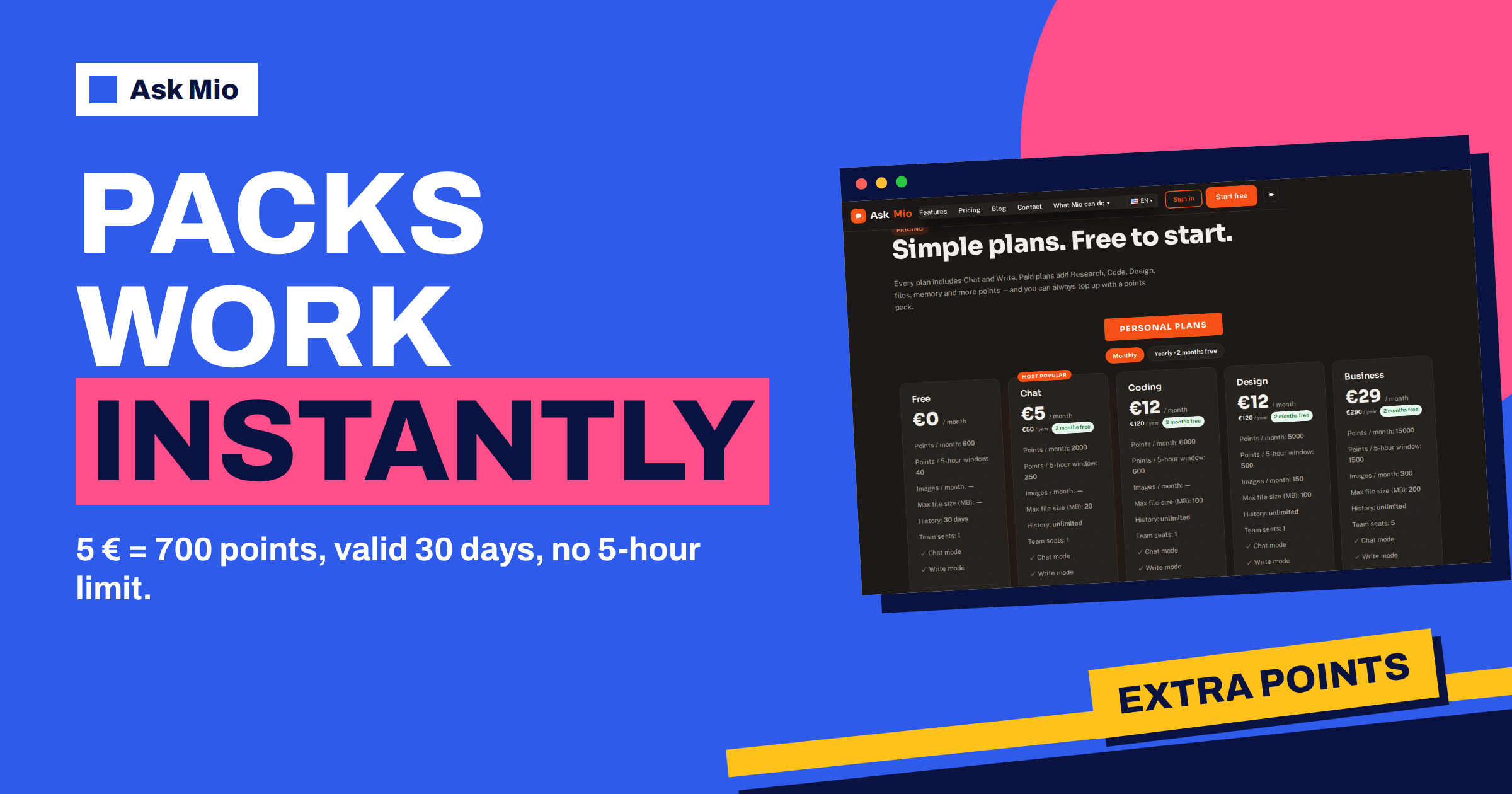
Ask Mio extra points exist for one situation: you have run out of points and the work cannot wait. A pack tops you up immediately, ignores the 5-hour window and lasts 30 days. That sounds simple, but a pack is not always the cheapest answer. Sometimes the better move is to wait for the window to reset, and sometimes it is to move to a bigger plan.
This guide gives you the numbers and a clear rule for each case. You will see what each pack costs per point, how the packs compare with the monthly plans, three situations where a pack is the right choice, three where an upgrade wins and how to avoid running dry in the first place. Every figure is taken from the live pricing page.
What Ask Mio extra points are
The pricing page lists three packs: 5 euros for 700 points, 10 euros for 1600 points and 25 euros for 4500 points. Three rules apply to all of them, and they are the reason packs are useful.
- They work immediately. There is no waiting for the next month or the next window.
- They are not limited by the 5-hour window. The window caps how fast you can spend plan points, but pack points are outside that cap.
- They are valid for 30 days. Unused points expire, so a pack is for a defined burst of work, not a savings account.
Prices are in euros, VAT at 21 percent is added at checkout, and you can pay by card, PayPal or bank transfer. The option to buy extra points is ticked on the Chat, Coding, Design and Business plans. The Free plan’s feature list does not include it, so on Free the choices are to wait for the window or to move to a paid plan.
Points, windows and what they cost
A point is the unit Mio uses instead of tokens. A normal chat reply costs 1 point, a long or complex one 3, a coding answer 5 to 10 and a generated image 20. Your plan gives a monthly amount and a 5-hour allowance. If you want the full reasoning behind this system, read our explainer on tokens versus points.
You can run out in two different ways, and the cure differs.
- You hit the 5-hour window. The month still has points, but the allowance for this stretch is gone. You can wait for the window to reset or buy a pack, because packs ignore the window.
- You hit the monthly limit. The plan has nothing left until the next month. A pack or an upgrade is the only way to continue sooner.
Knowing which one you hit is the first step. If it is the window, waiting a few hours is free. If it is the month, the decision below applies.
Price per point: packs against plans
Divide the price by the points and you get the cost of one point. The pack figures use the headline prices without VAT, and the plan figures use the monthly prices.
| Option | Price | Points | Cost per 100 points |
|---|---|---|---|
| Pack small | 5 € | 700 | 0.71 € |
| Pack medium | 10 € | 1600 | 0.63 € |
| Pack large | 25 € | 4500 | 0.56 € |
| Chat plan | 5 € per month | 2000 | 0.25 € |
| Design plan | 12 € per month | 5000 | 0.24 € |
| Coding plan | 12 € per month | 6000 | 0.20 € |
| Business plan | 29 € per month | 15000 | 0.19 € |
The pattern is clear. Pack points cost roughly two to three times as much as plan points, and larger packs are cheaper per point than small ones. That is the price of flexibility: you pay more per point for points that arrive instantly and outside the window. Plan points are the cheap ones, so the default strategy is to choose a plan that covers your normal month and use packs only for exceptions. You can see the plans side by side in our plan comparison.
Three situations where a pack is the right choice
One-off deadline. A report is due on Friday and Wednesday evening the points run out. A 5 euro pack for 700 points gets you through without changing your plan. Next month you are back to normal.
A heavy session that the window blocks. You are in the middle of a long document review and the 5-hour allowance is used up, but the month has points left. Packs are not limited by the window, so the work continues. Buy the smallest pack that covers the task.
An unusual month. A product launch, an exam week or a quarter-end close can double your usage for a few weeks. A medium pack costs less than a permanent upgrade if the surge will not repeat.
In all three, the common thread is that the need is temporary. You are paying a premium for speed and flexibility, and you stop paying when the need ends.
Three situations where an upgrade wins
Packs every month. If you buy a 10 euro pack each month on top of the Chat plan, you pay 15 euros for 3600 points. The Coding plan costs 12 euros for 6000 points, and the Design plan 12 euros for 5000 points. Repeated packs mean the plan is too small.
You need a feature, not points. If the real gap is Code mode, the sandbox or images, points will not fix it. The Coding plan adds the code mode and sandbox, as described in our Coding plan guide, and the Design plan adds 150 images a month, as covered in the Design plan article.
A team is sharing the pool. The Business plan has 15000 points a month, a 1500-point window and five seats. When several people share one allowance, buying packs for one person at a time is clumsy. Our guide to the Business plan shows how a small team can set up shared projects.
A simple test: if you bought packs in two of the last three months, upgrade. If you bought one pack in six months, keep buying packs.
Which pack should you choose
Match the pack to the work, not to the price. The cheapest pack per point is the 25 euro pack, but it is a poor choice if you will use only 300 points, because the rest expire in 30 days.
- 5 euros for 700 points: about 700 normal replies, or 70 coding answers at 10 points, or 35 generated images. Good for a single deadline.
- 10 euros for 1600 points: a busy fortnight or one large project. Good when you know the work will take a week or two.
- 25 euros for 4500 points: a launch, a team crunch or a month where you expect to double your usage. Choose it only if you will really use most of it within 30 days.
Estimate before buying. Count the tasks you still have to do, multiply by the point cost of each type and add 20 percent. Our guide to estimating credits per month gives a method you can reuse.
A quick decision guide
When the points run out, ask four questions in this order.
- Is the month empty, or only the window? If only the window, decide whether a few hours of waiting is acceptable.
- Does the work have a deadline today? If yes, a pack removes the wait. If no, wait.
- Is this the first time this quarter? One pack is fine. A pattern means an upgrade.
- Will I use the whole pack in 30 days? If not, pick the smaller size.
Four honest answers take less than a minute and usually point to the right choice without any spreadsheet.
How to avoid running out
Prevention is cheaper than any pack. These habits keep points where they matter.
- Use the right mode. A quick factual question belongs in Chat at 1 point, not in a long research answer at 3 points.
- Write one good prompt instead of five rounds. A clear brief saves more points than any trick. Our guide on how to write an AI prompt shows how.
- Batch similar work. Ask for ten product descriptions in one request instead of ten requests.
- Keep images for the final step. An image costs 20 points, the same as 20 normal replies, so settle the concept in text first.
- Watch the window. If you know a heavy session is coming, start it when the window is fresh.
The features page also mentions Headroom, which shortens repeated file dumps and quoted text in long chats so they stay cheap, and the chat shows how much was saved. Long conversations that carry big files are a common reason for points disappearing, so it is worth keeping chats focused.
A worked example: a freelancer’s launch week
A freelance designer is on the Design plan, which gives 5000 points and 150 images a month. In the last week of the month she prepares a client launch. She generates 60 images at 20 points each, which is 1200 points, and writes copy and emails for another 300. By Thursday she has used 4800 of her 5000 points and still needs 12 more images and the final copy.
She estimates 400 points, adds 20 percent for revisions and buys the 5 euro pack of 700 points. The pack works immediately, so she finishes on Friday. She notes that the pack points expire in 30 days and plans not to need another. The following month her usage returns to 3000 points, so she keeps the plan she has. Spending 5 euros once was cheaper than moving to a plan she would not use.
Mistakes to avoid
- Buying a large pack out of habit. Unused points expire after 30 days.
- Treating packs as a permanent plan. Repeated purchases cost two to three times more per point than a plan.
- Ignoring VAT. The checkout adds 21 percent, so the final amount is higher than the headline price.
- Forgetting the free option. If only the window blocked you, a few hours of waiting costs nothing.
- Upgrading for points alone when you need a feature. Check which mode you actually lack.
Read the VAT explanation on Wikipedia if you are unsure how it appears at checkout, and keep a simple budget of your monthly AI work so a pack becomes a planned decision.
Frequently Asked Questions
How much do Ask Mio extra points cost?
The packs cost 5 euros for 700 points, 10 euros for 1600 points and 25 euros for 4500 points. Prices are in euros and VAT at 21 percent is added at checkout. You can pay by card, PayPal or bank transfer, and the points are available immediately.
Do extra points expire?
Yes. The pricing page says packs are valid for 30 days. Unused points do not carry on beyond that, so buy a pack when you have a defined piece of work and choose a size you expect to use within the month.
Are extra points limited by the 5-hour window?
No. Packs work immediately and are not limited by the 5-hour window. That makes them useful when a heavy session uses up the window while the month still has points, or when a deadline cannot wait for the window to reset.
Can I buy extra points on the Free plan?
The Free plan’s feature list does not include buying extra points, while Chat, Coding, Design and Business all do. On Free you can wait for the 5-hour window to reset, or move to a paid plan, starting from 5 euros a month.
When is it better to upgrade than to buy a pack?
Upgrade if you buy packs in most months, need a feature such as Code mode, images or team seats, or share one allowance across a team. Plan points cost far less than pack points, so a regular need is cheaper on a bigger plan.
The Bottom Line
Ask Mio extra points are a flexible safety valve: instant, outside the 5-hour window and valid for 30 days. Use them for one-off deadlines and unusual weeks, and choose a bigger plan if you need packs month after month or a feature your plan lacks. Check your usage, estimate the work ahead and compare options on the Ask Mio pricing page.