
 Lietuviškai
 Deutsch
 Français
 Русский
 Español
 Polski
 Italiano
 Українська
 Čeština
 Português
 日本語
 Latviešu valoda
 Eesti
 Magyar
 Bahasa Indonesia
 Türkçe
 हिन्दी
 Ελληνικά
 العربية
 ไทย
 Tiếng Việt
 Română
 Bahasa Melayu
 বাংলা
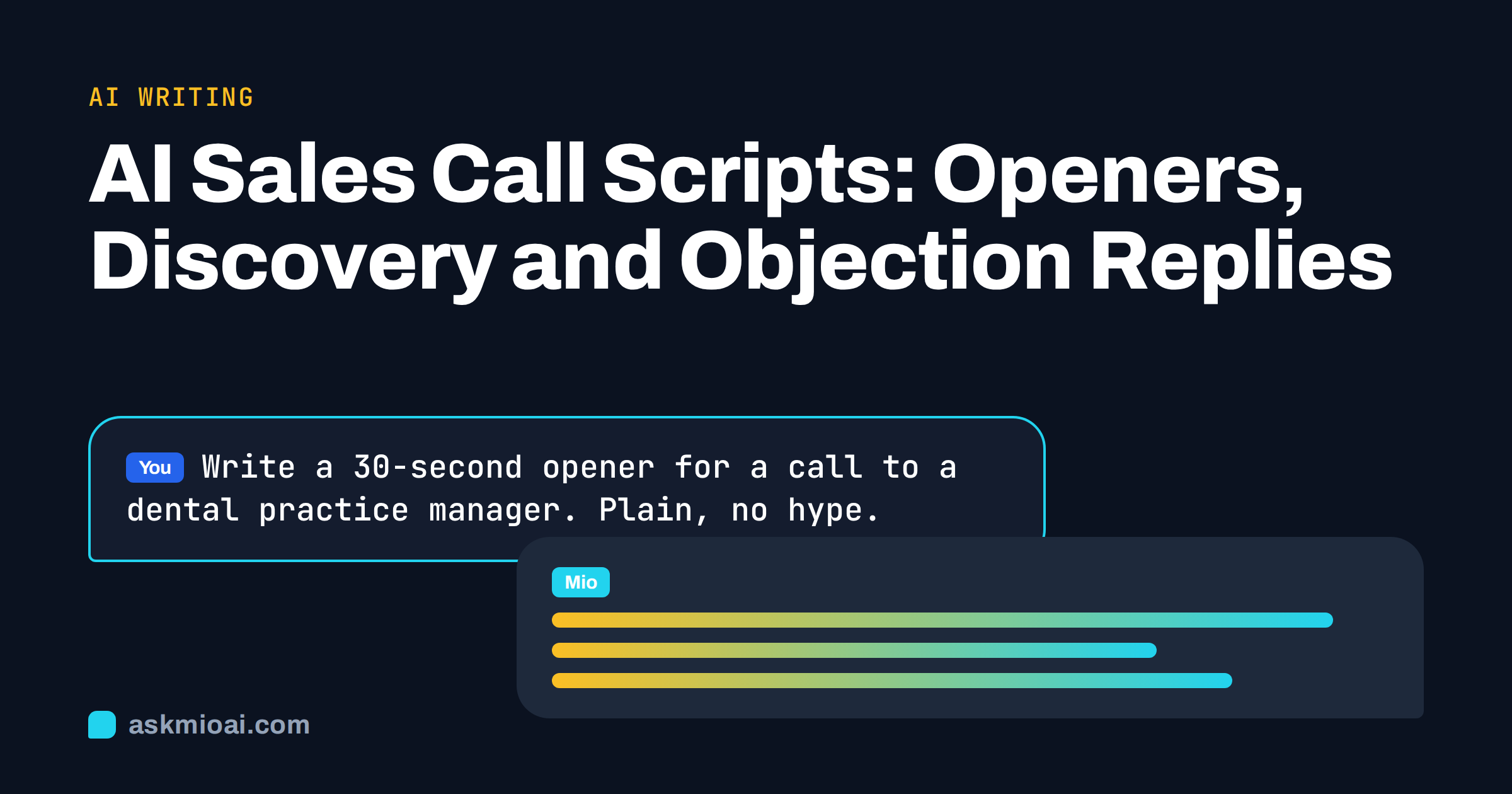
AI sales call scripts can save a salesperson hours of preparation, as long as the script is treated as a rehearsal aid and not as a speech to read word for word. A good call is a conversation. The best use of an assistant is to draft the opening, a set of discovery questions and a few replies to common objections, then to practise them until they sound like you.
This guide shows how to build AI sales call scripts that work: what facts to give the assistant, how to write an opener, which discovery questions to ask, how to prepare objection replies and how to rehearse. It also covers the rules to respect before you pick up the phone. The advice suits small teams, founders and anyone who makes outbound or inbound sales calls.
What AI sales call scripts are, and what they are not
Selling is a broad craft, and the general idea of sales covers everything from retail counters to complex enterprise deals. Phone calls are one slice of it. A script is a prepared plan for the structure of a call. It does not need to cover every sentence. Think of it as a map: you know where you want to start, which questions you want to ask and how to handle the stops that usually happen on the way. Cold calling and warm follow-up calls need different maps, and an assistant can draft either.
What an assistant does well is produce clean structure and many variations quickly. What it cannot do is know your customer, hear tone or decide when to stop talking. A script that sounds smooth on paper often sounds stiff aloud, so the work does not end when the text appears.
| Part of the call | Purpose | What the assistant drafts |
|---|---|---|
| Opener | Say who you are and why you called in about 20 seconds | Several versions at different tones |
| Discovery | Learn the buyer’s situation, needs and constraints | Open questions in a logical order |
| Value statement | Connect what you do to what you heard | Short statements using the buyer’s words |
| Objection replies | Respond calmly to doubts and refusals | Reply options with a follow-up question |
| Next step | Agree a concrete action | Closing lines that propose a time or a step |
| Voicemail and follow-up | Leave a short message and a written recap | Ten-second voicemail and a short email |
Give the assistant real facts first
A script built from a vague prompt will be generic, and a generic opener is the fastest way to be hung up on. Collect facts before you write the prompt. The more specific you are about the buyer and your offer, the less the assistant has to guess.
- Who you call: job title, company size, industry and the problem that person usually owns.
- Why now: a trigger such as a new hire, a growth announcement, a form they filled in or a mutual contact.
- What you offer: one plain sentence about the outcome, without jargon.
- Proof you can state: a real result or a type of customer you serve. Do not invent numbers.
- The goal of the call: a meeting, a demo, a trial or a qualification answer.
- Your constraints: words to avoid, claims you cannot make and the tone of your brand.
The guide on AI customer persona generators shows how to describe a buyer in a way that helps writing, and the article on AI for sales teams covers where an assistant fits in the wider sales routine.
Write an opener that earns thirty seconds
The first twenty seconds decide whether the call continues. A good opener says who you are, shows that you know something about the person’s situation and asks for permission or a short conversation. It avoids hype, flattery and long introductions about your company.
Try a prompt like this: “Write a 30-second opener for a call to a dental practice manager. My company provides appointment reminder software that reduces no-shows. I noticed the practice recently added a second location. Tone: plain and respectful. No hype and no claims about results. End with a question that asks if now is a reasonable time.” Ask for five versions, then pick the best parts of each.
- Name and company: short and clear, spoken slowly.
- Reason for the call: one sentence, tied to something real about them.
- Permission question: “Is this a reasonable time for a minute?” respects their schedule.
- Exit: if they are busy, offer to call back at a time they name.
Read each version aloud. If you run out of breath or stumble over a phrase, rewrite it. Spoken language uses shorter sentences and simpler words than written language, and the assistant often defaults to the written form. Ask it to “write as someone would say it on the phone”.
Discovery questions that open the conversation
Discovery is the heart of a call. Your aim is to understand the buyer’s situation well enough to know whether you can help. An assistant can draft a list of open questions in a sensible order, which you then trim to five or six that fit the time you have.
- Situation: “How do you handle appointment reminders today?”
- Problem: “What happens when a patient does not show up?”
- Impact: “How often does that happen in a typical week, and what does it cost the practice?”
- Priority: “Where does this sit among the things you want to fix this quarter?”
- Decision: “Who else would be involved in choosing a solution?”
- Timing: “Is there a date by which you would like this in place?”
Ask the assistant to flag questions that sound like interrogation and to rephrase them as natural curiosity. Also ask for follow-up prompts, such as “Tell me more about that”, because the best discovery happens in the second and third question, not the first. The article on AI survey analysis shows how to find patterns in what buyers say, and the same habit works for your call notes.
Prepare calm replies to common objections
Objections are a normal part of selling, and most of them fall into a few groups: not interested, no time, no budget, already have a supplier and send me an email. Prepare a reply for each, not to argue but to keep the conversation respectful and to learn what is behind the response.
| Objection | What it often means | Reply approach |
|---|---|---|
| “Not interested” | No visible reason to talk yet | Acknowledge, ask one light question or end politely |
| “I’m busy” | Bad timing | Offer a specific later time and keep your word |
| “We have no budget” | Unclear value or unclear priority | Ask what would need to be true for it to become a priority |
| “We already use someone” | Satisfied or inert | Ask what they like and what they would change |
| “Send me an email” | Polite brush-off or genuine interest | Agree and ask what they would want to see in it |
Ask the assistant for two or three short replies for each objection, each ending with a question. Then remove anything pushy. A reply that tries to defeat the objection usually fails, and a reply that respects it and asks a question often works. For deeper practice on difficult conversations, the guide to AI negotiation preparation uses a similar method.
Rehearse until it sounds like you
Practice is where most of the improvement happens, and it costs nothing but time. Even ten minutes a day for a week changes how an opener sounds. Rehearsal turns a script into a skill. You can practise alone, with a colleague or with an assistant playing the buyer. In a chat, tell the assistant who the buyer is, how sceptical they should be and ask it to respond one line at a time. Speak your lines aloud, or type them as you would say them, and ask for feedback after five exchanges.
- Set the scene: the buyer’s role, mood and likely objections.
- Play the opener and the first two questions.
- Ask the assistant to raise one objection of its choice.
- Answer, and then ask it to point out where you sounded pushy, vague or scripted.
- Rewrite the weakest line and run it again.
Record yourself, if your company’s rules allow it, and listen for filler words, speed and the length of your answers. Aim to talk less than the buyer during discovery. The guide on AI mock interview practice uses the same practice loop for another type of conversation.
Rules to check before you call
Sales calls are regulated in many places, and the rules differ by country, region and type of customer. Some places keep do-not-call lists, some require you to identify yourself and your company, and many have rules about calling mobile numbers, recording and automated dialling. Business-to-business and consumer calls are often treated differently.
- Check the rules for the country and region you are calling, using official sources.
- Respect do-not-call requests immediately and keep a record.
- Do not claim a result, a discount or a relationship that is not true.
- Tell people when a call is being recorded where the law or your policy requires it.
- Keep personal data out of chats with an assistant, and use placeholders for names and numbers.
Our article on AI meeting recording and consent explains what to tell people when a conversation is recorded or transcribed. When in doubt, ask your legal or compliance contact, because a clever script cannot repair a call that should not have been made.
Using Mio for your call preparation
Mio is a good fit for the preparation work. Write mode helps with openers, voicemails and follow-up emails, Chat mode works as a practice partner and Research mode, on paid plans, can look up a company and cite sources so your opener is based on something real. Projects let you store your product facts, tone and banned claims once, so every new chat begins with the same rules.
Chats and files are your own, they are not used to train models and you can export or delete them at any time. The free plan includes Chat and Write, which is enough to draft a script and rehearse it. For follow-up, ask Mio to turn your call notes into a short recap email and a list of next steps. The guide to AI cold email writing covers the written side of outreach.
Frequently Asked Questions
Can AI write a good sales call script?
It can write a solid structure: opener, discovery questions, objection replies and a closing step. To make it good, give it real facts about the buyer and your offer, then edit for spoken language and rehearse. A script used word for word will sound stiff, so treat it as a plan.
How long should a cold call opener be?
About twenty to thirty seconds when spoken. Say who you are, give one specific reason for calling and ask whether it is a good time. Longer introductions lose the listener. Prepare a shorter version for gatekeepers and a ten-second version for voicemail, and practise all of them aloud.
What are good discovery questions?
Open questions about the buyer’s situation, problem, impact, priority, decision process and timing. Examples include how they handle something today, what happens when it goes wrong and who else is involved in the decision. Choose five or six, and listen for details that deserve a follow-up question.
Should I read the script during the call?
No. Reading sounds unnatural and makes it harder to listen. Keep a one-page outline with your opener, key questions and a few objection replies in front of you, and rely on practice for the wording. Notes help you stay on track without turning the call into a recital.
Is it legal to use AI to prepare sales calls?
Preparing a script with an assistant is not a legal problem in itself. The rules apply to the call: who you may contact, how you identify yourself, whether you record and how you handle personal data. Check local rules through official sources, and keep customer details out of chats where possible.
The Bottom Line
AI sales call scripts are most useful as preparation: a clear opener, thoughtful discovery questions, calm objection replies and a lot of rehearsal. Feed the assistant real facts, rewrite for spoken language, respect the rules for calling and keep your own voice. To start drafting and practising, try the free plan and compare options on the Ask Mio pricing page.