
 Lietuviškai
 Deutsch
 Français
 Русский
 Español
 Polski
 Italiano
 Українська
 Čeština
 Português
 日本語
 Latviešu valoda
 Eesti
 Magyar
 Bahasa Indonesia
 Türkçe
 हिन्दी
 Ελληνικά
 العربية
 ไทย
 Tiếng Việt
 Română
 Bahasa Melayu
 বাংলা
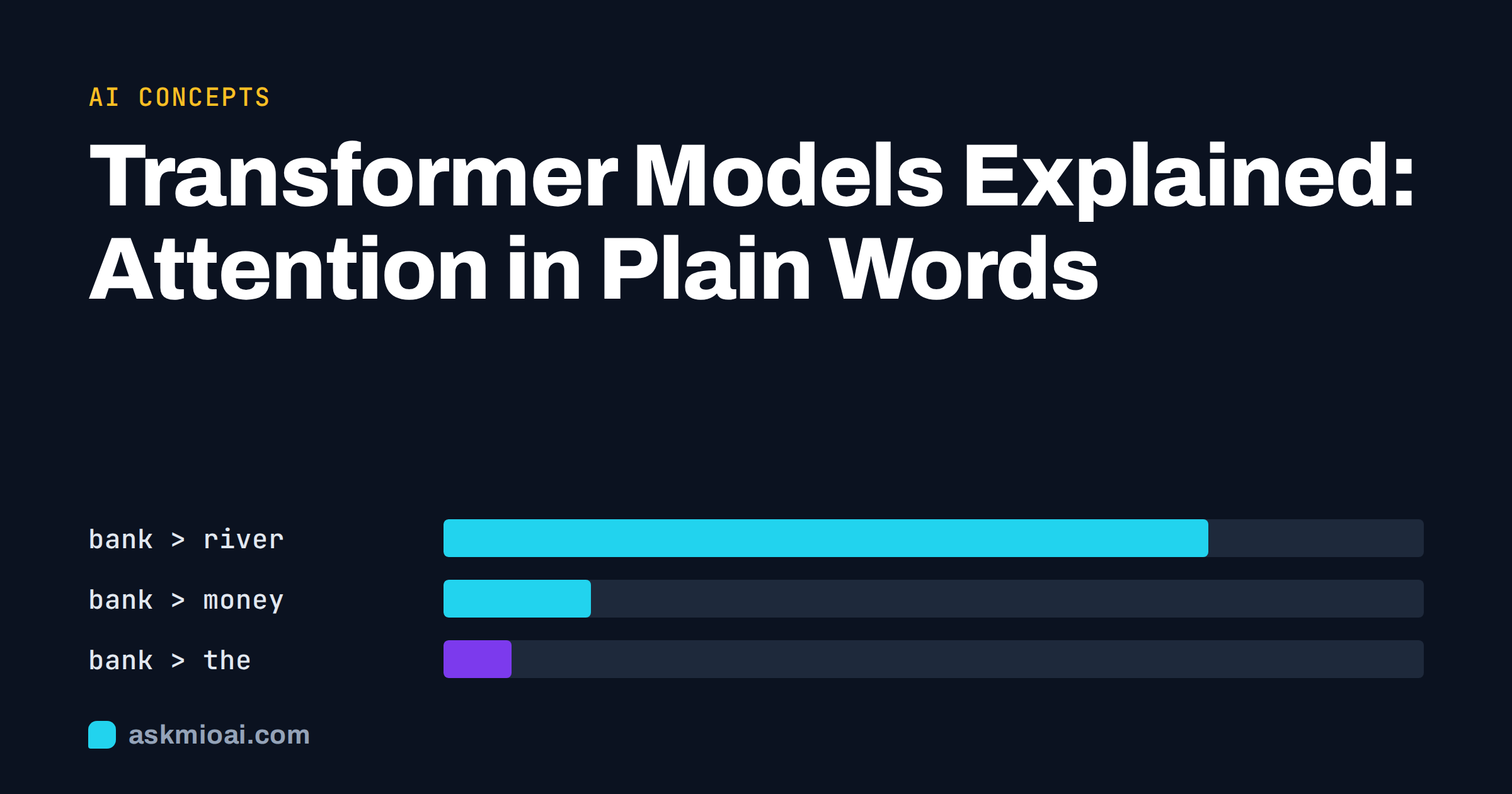
Transformer models are the design behind most of today’s AI assistants, and the idea at their centre is simpler than the name suggests: when the model reads a word, it decides how much attention to pay to every other word around it. That one trick lets it work out that “bank” means a river edge in one sentence and a place for money in another. This article explains how transformer models work in plain words, why they replaced older designs and what their limits mean for the answers you get.
No maths is required. We use small examples and a few analogies, and we say clearly where they stop being accurate.
What transformer models are, in one paragraph
A transformer is a type of neural network built to process sequences, such as the words of a sentence. It first splits text into small pieces called tokens, turns each token into a list of numbers, and then repeatedly lets those pieces exchange information with each other through a mechanism called attention. After many layers of this, the model produces a score for every possible next token and picks one. Repeat that thousands of times and you get an answer.
The design was introduced in a 2017 research paper titled Attention Is All You Need. The title was a claim that attention alone, without the older step-by-step machinery, was enough. The claim held up well enough that nearly every major language model since has been a transformer or a close relative.
Step one: text becomes tokens, tokens become numbers
A model cannot read letters. Text is first cut into tokens: whole common words, parts of longer words, punctuation and spaces. A short word like “water” may be one token, while a rare long word may be several.
Each token is then replaced by a vector, which is simply a long list of numbers. These vectors are learned during training, and tokens with related meanings end up with similar numbers. If you want the longer story of how meaning becomes numbers, see what AI embeddings are.
Because the model processes all tokens at once, it needs a way to know their order. Without it, “the dog bit the man” and “the man bit the dog” would look identical. Transformers add a position signal to every token, so order is part of the input from the start.
Step two: attention, the core of transformer models
Attention answers one question for each token: which other tokens in this text matter for understanding me right now?
Take the sentence “She sat on the bank and watched the river.” When the model processes “bank”, attention gives a high weight to “river” and “sat” and a low weight to “the”. The result is that the numbers for “bank” are updated to carry a river-edge meaning. In a sentence about “a loan from the bank”, the weights point to “loan” instead, and “bank” is updated toward the financial meaning.
Queries, keys and values
The usual analogy is a library search. Each token produces three vectors:
- A query: what am I looking for?
- A key: what do I offer to others?
- A value: what information do I pass along if I am chosen?
The model compares each query with every key, turns the comparison scores into weights that add up to one, and takes a weighted mix of the values. A high match means a large share of that token’s information flows in. The analogy is imperfect, because nothing is looked up in a real index, but it captures the idea of matching and mixing.
Many heads at once
One attention pattern is not enough, since a word relates to others in several ways at once: grammar, meaning, position and reference. Transformers therefore run many attention “heads” in parallel, each free to learn a different pattern, and combine the results. Researchers have found heads that appear to track things such as which noun a pronoun refers to, although the picture is messy and no single head holds a clean rule.
Step three: layers, and what they add up to
Attention is followed by a small neural network that processes each token on its own, and the pair of steps is repeated in a stack of layers. Early layers tend to capture simple patterns such as local word combinations. Later layers capture more abstract relationships, such as the topic of a paragraph or the tone of a request.
At the top, the final vector for the last token is turned into scores over the whole vocabulary. A sampling step then chooses the next token, and that is where settings such as temperature come in. Our article on AI temperature explains why the same prompt can give different answers.
The key point is that the model writes one token at a time, feeding each new token back in as input. It does not plan the whole answer in advance in the way a person drafts an outline, although earlier layers may hold some information about where the sentence is heading.
Why transformers replaced older designs
Earlier language models read text strictly in order, one word after another, passing a summary forward. Two problems followed. They were slow to train because each step waited for the previous one, and they tended to forget the start of a long passage by the time they reached the end.
Transformers fixed both. All tokens are processed in parallel during training, which suits modern graphics processors, and attention lets any token look directly at any other token, however far apart. That combination made it practical to train much larger models on much more text, which is the main reason assistants improved so fast.
Transformer models and the context window
Attention has a cost. Comparing every token with every other token grows quickly with length, so models have a maximum number of tokens they can look at together. That limit is the context window. Everything inside it, including your messages, pasted documents and the model’s own replies, competes for attention. Material outside it is simply not seen.
This explains several everyday observations. A very long chat can drift because early instructions get less weight. A document pasted in the middle of a long conversation may be summarised less carefully than the same document in a fresh chat. Our guides to AI context windows and what happens when you press send go deeper into both.
How training shapes what a transformer knows
A transformer starts with random numbers. During pretraining, it reads huge amounts of text and is repeatedly asked to predict the next token. Every wrong guess nudges the numbers a little. After enough rounds the model has absorbed grammar, facts, writing styles and some reasoning patterns, all stored in its numbers rather than in any readable form.
A later stage teaches the model to behave like an assistant: to follow instructions, to refuse some requests and to answer in a helpful format. The difference between adjusting numbers and simply writing a better prompt is explained in fine-tuning versus prompting.
Two consequences matter for users. First, the model’s knowledge stops at its training cutoff. Second, it has no built-in way to check a claim against the world, which is why it can state something wrong in a confident voice. Tools such as web search help, but they are added around the model.
What transformer models are good and bad at
The mechanism explains the strengths and weaknesses people notice.
| Task | How well transformers handle it | Why |
|---|---|---|
| Writing and rewriting text | Strong | Predicting fluent continuations is what they are trained to do |
| Translation and summarising | Strong | Attention links words across the whole input |
| Code with common patterns | Strong | Code is regular text, and plenty of examples exist in training data |
| Exact arithmetic | Unreliable without a tool | The model predicts digits rather than calculating them |
| Recent facts | Weak unless it can search | Knowledge stops at the training cutoff |
| Counting letters or items | Often wrong | Tokens hide individual letters |
| Very long documents | Variable | Attention is spread thinly over many tokens |
| Knowing when it is wrong | Poor | Fluency and correctness are separate things |
This is why a good assistant combines the model with tools for calculation, web search and running code, rather than relying on the model alone.
How Ask Mio fits around transformer models
Ask Mio does not expose the model underneath. Mio routes each request to a model suited to the task, so you do not choose one, and paid plans get the stronger models. What you see are the tools built around those models: a Calculator for exact arithmetic, Web search and a Web page reader for current facts, and a Code runner for computing in a sandbox. Research mode adds cited sources so that you can check a claim instead of trusting the sentence.
That design follows directly from the limits above. A transformer is a very good writer and pattern finder, and an unreliable calculator and archive. Putting dependable tools beside it covers most of the weak spots. You can see the full list in our overview of the tools Mio uses mid-answer. The free plan includes Chat and Write modes with 600 points a month, which is enough to try the ideas in this article on your own questions.
Common misunderstandings about transformer models
- “It looks things up in a database.” A plain model does not. Knowledge is stored in numbers learned during training. Retrieval is something extra that systems add, as described in RAG AI explained.
- “It understands like a person.” It models patterns in language extremely well. Whether that amounts to understanding is a debate, but it does not have experience, intent or a way to verify claims.
- “Bigger is always better.” Size helps up to a point, but smaller models can win for fast, narrow tasks. See small language models explained.
- “Attention shows its reasoning.” Attention weights tell you where the model looked, not why it answered as it did. They are a clue, not an explanation.
- “It remembers our earlier chats.” Only what sits in the context window, or in a memory feature that stores notes and puts them back into the context.
Where to learn more
For a visual walk-through that goes a step beyond this article, The Illustrated Transformer is a widely used tutorial with diagrams of each step. For the original source, read the paper linked earlier; the first sections are surprisingly readable even if the equations are not. Learning the vocabulary of tokens, attention, layers and context is enough to read most discussion of new models with a critical eye.
Frequently Asked Questions
What is a transformer model in simple terms?
A transformer is a neural network that reads text as tokens and lets every token weigh how relevant every other token is. After many layers of this attention step, it predicts the next token. Repeating that prediction builds a full answer, one piece at a time.
What does attention actually do?
Attention lets the model update the meaning of each token using the other tokens around it. For example, it can decide that “bank” refers to a river in one sentence and to money in another by giving more weight to the clues nearby. It is a weighted mix of information.
Why do transformer models make mistakes?
They are trained to produce likely continuations of text, not to verify facts. That makes them fluent but sometimes wrong, especially about recent events, exact numbers or rare details. Assistants reduce this with tools such as search and calculation, but you should still check important claims.
Are all AI chat assistants built on transformers?
Most large language models behind current assistants are transformers or close variants. Other architectures exist and research continues, but the transformer design has dominated language models since 2017. The details of which model an assistant uses are often not published.
What is the difference between a transformer and a context window?
The transformer is the architecture. The context window is the maximum number of tokens it can attend to at once. A transformer with a bigger window can read longer documents, but attention is still spread across everything inside the window.
Do I need to know this to use an AI assistant well?
No, but a basic picture helps. Knowing that the model predicts tokens and has a limited window explains why clear prompts help, why long chats drift and why you should verify facts. You can use Ask Mio effectively without any of the technical detail.
The Bottom Line
Transformer models work by turning text into tokens and letting attention decide which parts of the text matter for each next step. That makes them excellent at language and patterns, and unreliable as calculators, archives and fact checkers, which is why good assistants add tools around them. Use that picture to write clearer prompts and to check what matters. To try it yourself, start on the free Ask Mio plan; no card is needed.