
 Lietuviškai
 Deutsch
 Français
 Русский
 Español
 Polski
 Italiano
 Українська
 Čeština
 Português
 日本語
 Latviešu valoda
 Eesti
 Magyar
 Bahasa Indonesia
 Türkçe
 हिन्दी
 Ελληνικά
 العربية
 ไทย
 Tiếng Việt
 Română
 Bahasa Melayu
 বাংলা
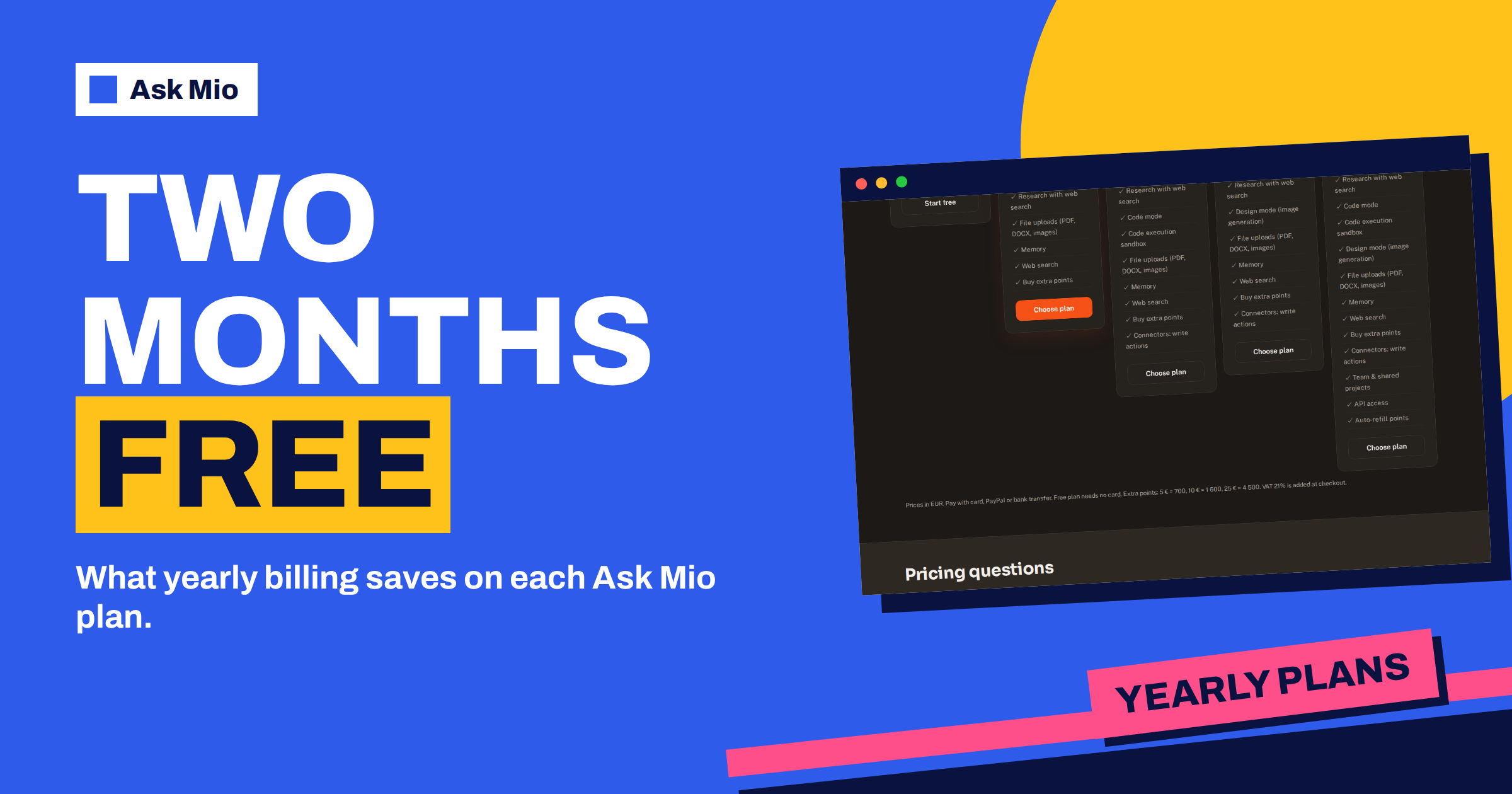
The Ask Mio yearly plans carry one promise on the pricing page: two months free. Every paid plan has a yearly option, and the claim is easy to check: the yearly price is ten times the monthly price, so you pay for ten months and use twelve. What is harder to judge is whether the yearly plan is right for you. A discount only helps if you would have paid for those twelve months anyway.
This guide does the arithmetic for each plan, shows the break-even point, lists the situations where yearly billing is a good idea and the ones where monthly is safer, and explains how VAT and payment methods fit in. All figures come from the live pricing page, so you can verify them before you pay.
What the Ask Mio yearly plans cost
The pricing page has a switch between Monthly and Yearly with the label “2 months free”. Four plans have a yearly price. The free plan costs nothing, so it has no yearly option.
| Plan | Monthly price | Twelve months monthly | Yearly price | You save | Effective monthly price |
|---|---|---|---|---|---|
| Chat | 5 € | 60 € | 50 € | 10 € | 4.17 € |
| Coding | 12 € | 144 € | 120 € | 24 € | 10.00 € |
| Design | 12 € | 144 € | 120 € | 24 € | 10.00 € |
| Business | 29 € | 348 € | 290 € | 58 € | 24.17 € |
The saving is the same share on every plan: two months out of twelve, or about 16.7 percent. A larger plan therefore saves more euros, but not a bigger percentage. Prices are in euros and VAT at 21 percent is added at checkout, so if that rate applies to you, the yearly Chat plan comes to 60.50 euros including VAT, against 72.60 euros for twelve monthly payments.
The plan limits themselves, such as 2000 points a month on Chat or 15000 on Business, are listed per month on the pricing page. Our plan comparison explains what each plan includes, and the tokens versus points guide explains how those points are spent.
The break-even point
The yearly plan equals ten monthly payments. If you would use the monthly plan for ten months or more in the next twelve, the yearly option is cheaper. If you would use it for fewer than ten, monthly billing costs less, because you can stop when the need ends.
A simple way to think about it: ask how many months of the next twelve you are confident you will need Ask Mio at this level. Count only the months in which you have real work for it. If the answer is ten, eleven or twelve, choose yearly. If the answer is “maybe six”, stay monthly or start monthly and decide later. The idea is the same as any break-even analysis: the discount is worth taking only beyond the point where it pays for itself.
When yearly billing is a good idea
You already use it every week. If Mio has become part of your routine, such as drafting emails, preparing documents or checking code, you are unlikely to stop in a few months. Two free months are then pure savings.
You work on a long project. A thesis, a product launch or a year-long contract is a natural fit, because the need runs across the whole period.
You run a small business and want a fixed cost. Yearly billing makes the cost predictable and easy to budget. A single payment is also simpler to record than twelve.
You are a team. The Business plan has 15000 points a month, a 1500-point window and five seats. At 290 euros a year, that is about 4.83 euros per seat per month, against 5.80 euros on monthly billing. If your team is stable, the yearly price is a clear win. Our guide to the Business plan shows how a team of five can set up shared projects.
You tested it first. The best time to go yearly is after a trial period on a monthly plan or after the free plan has shown you that Mio fits your work. Then you are paying for something you know.
When monthly is the safer choice
Your need is seasonal. A student who works hard from September to June and not in summer, or an accountant who is busy for four months around the tax season, may spend less on monthly billing by stopping in quiet months.
You are still choosing the plan. Chat, Coding and Design differ in features, not just points. If you are not sure whether you need Code mode or Design mode, you should not commit for a year. Compare them in our guides to the Coding plan and the Design plan.
Your budget is tight. A yearly payment is a larger amount at one time, even if it saves money in total. If cash flow matters more than the discount, monthly billing keeps the outlay small.
Your business is uncertain. If you may close the project or change tools within a few months, flexibility is worth more than 16.7 percent.
Yearly billing and extra points
The yearly price covers the plan. Extra points are separate. The pricing page lists packs of 5 euros for 700 points, 10 euros for 1600 and 25 euros for 4500, valid for 30 days, not limited by the 5-hour window and available on the paid plans. The pricing page shows no yearly discount on them, and per point they cost two to three times as much as plan points. So a good yearly choice is a plan that covers your normal month without packs, with packs kept for rare peaks.
How to choose the plan before choosing the period
Choose the plan first and the billing period second. A discount on the wrong plan is not a bargain. Estimate your usage: count the tasks you do in a typical month and multiply by the point cost on the pricing page, which is 1 point for a normal reply, 3 for a long or complex one, 5 to 10 for a coding answer and 20 for a generated image. Add 20 percent for revisions. Our method for estimating credits per month walks through an example.
Then check features. Do you need Research and file uploads, which start with Chat? Do you need Code mode and the sandbox, which come with Coding and Business? Do you need image generation, which comes with Design and Business? Only when the plan fits should you look at the yearly discount.
Payment methods and VAT
The pricing page says you can pay with card, PayPal or bank transfer, and that VAT at 21 percent is added at checkout. The free plan needs no card. How VAT applies to you depends on your country and your status as a consumer or a business, so check the final amount on the checkout page before you confirm. Our explanation of VAT on Wikipedia gives the background, and your accountant can tell you how to treat it in your books.
For a company, a yearly payment is an easy item to budget and approve. For an individual, paying once avoids twelve small charges but asks for more money at one time.
A worked example: three buyers
Anna, a freelance translator. She uses Mio every working day for drafts and terminology checks, and expects to do so for years. She chooses the Chat plan yearly at 50 euros, against 60 euros monthly, and saves 10 euros. She needs no extra packs, because 2000 points a month are enough for her.
Tom, a student. He needs Mio for two terms of eight months of study and plans to stop in summer. He compares eight monthly payments of 5 euros, which is 40 euros, with a yearly payment of 50 euros. Monthly billing is cheaper for him, so he stays monthly and stops after the exams.
A five-person agency. The team already shares projects and will use Mio all year. The Business plan costs 290 euros yearly against 348 monthly, a saving of 58 euros. Over twelve months, the cost per person is 58 euros, which is easy to justify against the time saved. They also agree to keep one person responsible for monitoring points.
Lena, a developer who is not sure yet. She expects to need Code mode but has never used it daily. She starts on the monthly Coding plan at 12 euros, tracks how often she uses the sandbox and the points over two months and finds that she uses about 3000 of 6000 points. The plan fits, and she will still need it next year, so she moves to the yearly price of 120 euros at the next renewal. She loses nothing by waiting two months, and she buys the yearly plan with evidence instead of hope. The lesson is simple: when you are unsure, the monthly price is the cost of learning what you need.
Common mistakes with yearly billing
- Choosing the period before the plan. A cheaper year on the wrong plan is still the wrong plan.
- Counting months you will not use. Be honest about quiet months, holidays and the end of projects.
- Forgetting VAT. The headline price is not the final amount, so compare totals, not labels.
- Skipping the free plan. If 600 points a month do the job, you do not need to pay at all.
- Ignoring the team. On Business, one yearly payment covers five seats, so agree who owns the subscription and the renewal date.
- Not writing the renewal date down. Put it in your calendar so the decision is made on purpose next year.
Questions to ask yourself before paying
- Will I still need this plan in ten months?
- Is this the plan whose features I actually use?
- Can I afford the larger payment now without stress?
- Have I tried the free plan or a monthly month first?
- Do I know how the checkout shows VAT for my situation?
If all five answers are yes, go yearly. If any answer is no, start monthly and revisit the decision after a month or two.
Frequently Asked Questions
What does two months free mean on Ask Mio?
The yearly price is ten times the monthly price, so you pay for ten months and get twelve. For example, the Chat plan costs 5 euros a month or 50 euros a year, and the Business plan costs 29 euros a month or 290 euros a year.
Do all plans have a yearly option?
The Chat, Coding, Design and Business plans have a yearly price, shown on the pricing page when you switch to Yearly. The Free plan costs nothing and needs no card, so it has no yearly option. Prices are in euros and VAT at 21 percent is added at checkout.
Do I get more points on a yearly plan?
The pricing page lists points per month and per 5-hour window for each plan, and the yearly option changes the price, not those limits. For example, Chat gives 2000 points a month and 250 per window. If you need more, extra points can be bought.
Is yearly always cheaper?
Only if you would otherwise pay for ten or more months. The yearly price equals ten monthly payments. If you only need Mio for a few months, such as an exam season, monthly billing costs less because you can stop when the work ends.
Which payment methods work for the yearly plan?
The pricing page says you can pay with card, PayPal or bank transfer, and that the free plan needs no card. VAT at 21 percent is added at checkout, so confirm the final amount on the checkout page before you pay, especially if you are paying as a company.
The Bottom Line
The Ask Mio yearly plans save two months on every paid plan: 10 euros on Chat, 24 on Coding and Design and 58 on Business. They pay off if you will use the plan ten months or more, and they cost more if you will stop earlier. Pick the plan that fits your work first, try it monthly if you are unsure, then switch to the period that matches your real use. Compare all options on the Ask Mio pricing page.